18. this is a chemical that reflects heat from the sun, warming the planet:\na) greenhouse gas\nb) noble…
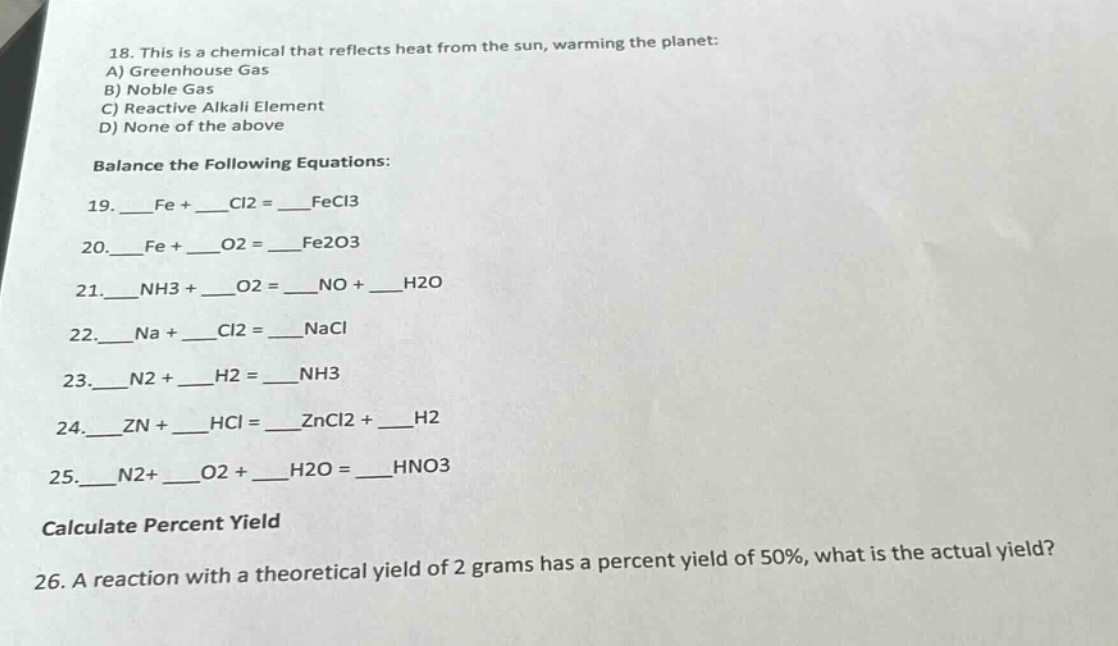
18. this is a chemical that reflects heat from the sun, warming the planet:\na) greenhouse gas\nb) noble gas\nc) reactive alkali element\nd) none of the above\nbalance the following equations:\n19. ___fe + ___cl2 = ___fecl3\n20. ___fe + ___o2 = ___fe2o3\n21. ___nh3 + ___o2 = ___no + ___h2o\n22. ___na + ___cl2 = ___nacl\n23. ___n2 + ___h2 = ___nh3\n24. ___zn + ___hcl = ___zncl2 + ___h2\n25. ___n2+ ___o2 + ___h2o = ___hno3\ncalculate percent yield\n26. a reaction with a theoretical yield of 2 grams has a percent yield of 50%, what is the actual yield?
Answer
18. Multiple - choice question
Brief Explanations:
- Greenhouse Gas: Greenhouse gases (such as (CO_2), (CH_4) etc.) trap heat (not reflect heat) from the sun, warming the planet.
- Noble Gas: Noble gases are generally inert and do not play a role in warming the planet by reflecting or trapping heat in the context described.
- Reactive Alkali Element: Reactive alkali elements (like (Na), (K) etc.) are not chemicals that reflect heat from the sun to warm the planet.
Answer:
D. None of the above
19. Balancing (Fe + Cl_2=FeCl_3)
Step - by - Step Format:
Explanation:
Step1: Balance Cl atoms
The left - hand side has (2) Cl atoms ((Cl_2)) and the right - hand side has (3) Cl atoms ((FeCl_3)). The least common multiple of (2) and (3) is (6). So, we put a coefficient of (3) in front of (Cl_2) and (2) in front of (FeCl_3): (Fe+3Cl_2 = 2FeCl_3)
Step2: Balance Fe atoms
Now, on the right - hand side, we have (2) Fe atoms. So, we put a coefficient of (2) in front of (Fe) on the left - hand side.
Answer:
(2Fe + 3Cl_2=2FeCl_3)
20. Balancing (Fe + O_2 = Fe_2O_3)
Step - by - Step Format:
Explanation:
Step1: Balance O atoms
The left - hand side has (2) O atoms ((O_2)) and the right - hand side has (3) O atoms ((Fe_2O_3)). The least common multiple of (2) and (3) is (6). So, we put a coefficient of (3) in front of (O_2) and (2) in front of (Fe_2O_3): (Fe + 3O_2=2Fe_2O_3)
Step2: Balance Fe atoms
Now, on the right - hand side, we have (4) Fe atoms. So, we put a coefficient of (4) in front of (Fe) on the left - hand side.
Answer:
(4Fe+3O_2 = 2Fe_2O_3)
21. Balancing (NH_3+O_2 = NO + H_2O)
Step - by - Step Format:
Explanation:
Step1: Balance H atoms
Let's first balance the H atoms. There are (3) H atoms in (NH_3) and (2) H atoms in (H_2O). The least common multiple of (3) and (2) is (6). So, we put a coefficient of (2) in front of (NH_3) and (3) in front of (H_2O): (2NH_3+O_2=NO + 3H_2O)
Step2: Balance N atoms
Since we have (2) N atoms on the left ((2NH_3)), we put a coefficient of (2) in front of (NO): (2NH_3+O_2 = 2NO+3H_2O)
Step3: Balance O atoms
On the right - hand side, we have (2 + 3=5) O atoms. On the left - hand side, we have (2) O atoms ((O_2)). We multiply the entire equation by (2) to get rid of the fraction. So, (4NH_3+5O_2=4NO + 6H_2O)
Answer:
(4NH_3+5O_2=4NO + 6H_2O)
22. Balancing (Na+Cl_2 = NaCl)
Step - by - Step Format:
Explanation:
Step1: Balance Cl atoms
The left - hand side has (2) Cl atoms ((Cl_2)) and the right - hand side has (1) Cl atom ((NaCl)). So, we put a coefficient of (2) in front of (NaCl): (Na+Cl_2=2NaCl)
Step2: Balance Na atoms
Now, on the right - hand side, we have (2) Na atoms. So, we put a coefficient of (2) in front of (Na) on the left - hand side.
Answer:
(2Na+Cl_2 = 2NaCl)
23. Balancing (N_2+H_2=NH_3)
Step - by - Step Format:
Explanation:
Step1: Balance N atoms
The left - hand side has (2) N atoms ((N_2)) and the right - hand side has (1) N atom ((NH_3)). So, we put a coefficient of (2) in front of (NH_3): (N_2+H_2=2NH_3)
Step2: Balance H atoms
Now, on the right - hand side, we have (6) H atoms. So, we put a coefficient of (3) in front of (H_2) on the left - hand side.
Answer:
(N_2 + 3H_2=2NH_3)
24. Balancing (Zn+HCl=ZnCl_2+H_2)
Step - by - Step Format:
Explanation:
Step1: Balance Cl atoms
The left - hand side has (1) Cl atom ((HCl)) and the right - hand side has (2) Cl atoms ((ZnCl_2)). So, we put a coefficient of (2) in front of (HCl): (Zn + 2HCl=ZnCl_2+H_2)
Step2: Check other atoms
Zn is balanced ((1) on each side), and H is also balanced ((2) on each side)
Answer:
(Zn+2HCl=ZnCl_2 + H_2)
25. Balancing (N_2+O_2+H_2O=HNO_3)
Step - by - Step Format:
Explanation:
Step1: Balance N atoms
The left - hand side has (2) N atoms ((N_2)) and the right - hand side has (1) N atom ((HNO_3)). So, we put a coefficient of (2) in front of (HNO_3): (N_2+O_2+H_2O=2HNO_3)
Step2: Balance H atoms
Now, on the right - hand side, we have (2) H atoms. So, we put a coefficient of (1) in front of (H_2O) (already balanced for H)
Step3: Balance O atoms
On the right - hand side, we have (6) O atoms ((2HNO_3)). On the left - hand side, we have (2 + 1=3) O atoms. So, we put a coefficient of (\frac{5}{2}) in front of (O_2). Multiply the entire equation by (2) to get (2N_2+5O_2 + 2H_2O=4HNO_3)
Answer:
(2N_2+5O_2+2H_2O = 4HNO_3)
26. Calculating percent yield
Step - by - Step Format:
Explanation:
Step1: Recall the percent - yield formula
The percent - yield formula is (\text{Percent Yield}=\frac{\text{Actual Yield}}{\text{Theoretical Yield}}\times100%) We are given that (\text{Percent Yield}=50%=\frac{50}{100} = 0.5) and (\text{Theoretical Yield}=2\space g)
Step2: Solve for the actual yield
From (\text{Percent Yield}=\frac{\text{Actual Yield}}{\text{Theoretical Yield}}), we can rewrite it as (\text{Actual Yield}=\text{Percent Yield}\times\text{Theoretical Yield}) Substitute the values: (\text{Actual Yield}=0.5\times2\space g)
Answer:
(1\space g)