18. sulfur\nsymbol:\natomic number:\natomic mass:\nprotons:\nneutrons:\nelectrons:\n19. phosphorus\nsymbol:\n…
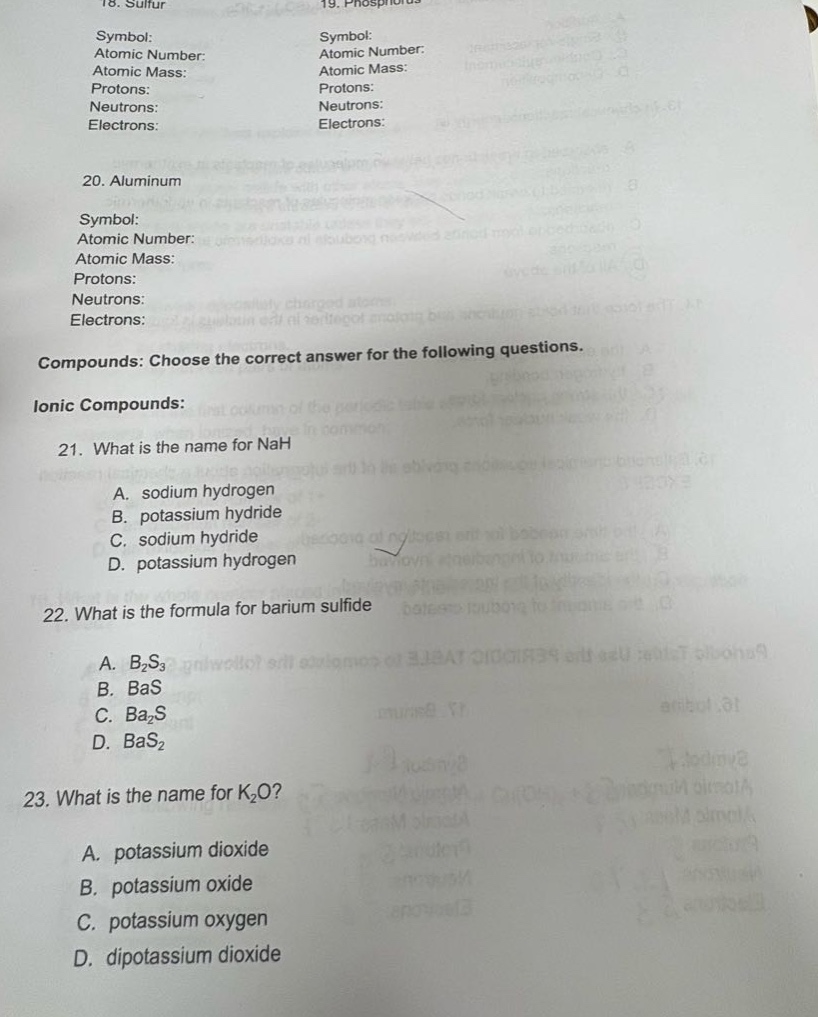
18. sulfur\nsymbol:\natomic number:\natomic mass:\nprotons:\nneutrons:\nelectrons:\n19. phosphorus\nsymbol:\natomic number:\natomic mass:\nprotons:\nneutrons:\nelectrons:\n20. aluminum\nsymbol:\natomic number:\natomic mass:\nprotons:\nneutrons:\nelectrons:\ncompounds: choose the correct answer for the following questions.\nionic compounds:\n21. what is the name for nah\na. sodium hydrogen\nb. potassium hydride\nc. sodium hydride\nd. potassium hydrogen\n22. what is the formula for barium sulfide\na. b₂s₃\nb. bas\nc. ba₂s\nd. bas₂\n23. what is the name for k₂o?\na. potassium dioxide\nb. potassium oxide\nc. potassium oxygen\nd. dipotassium dioxide
Answer
Explanation:
Step1: Recall naming rules for ionic compounds
In naming ionic compounds, the name of the metal (cation) comes first followed by the non - metal (anion) with the anion ending in - ide. For NaH, Na is sodium and H is hydride, so it is sodium hydride.
Step2: Determine formula for barium sulfide
Barium has a +2 charge ($Ba^{2+}$) and sulfur has a - 2 charge ($S^{2 -}$). To form a neutral compound, the ratio is 1:1, so the formula is BaS.
Step3: Name $K_2O$
Potassium ($K^+$) and oxygen ($O^{2 -}$) form a compound. The name of the metal is potassium and the non - metal oxygen becomes oxide, so it is potassium oxide.
Answer:
- C. sodium hydride
- B. BaS
- B. potassium oxide