25. which of the following is a decomposition reaction?\ncaco₃(s) → cao(s) + co₂(g)\n4al(s) + 3o₂(g) →…
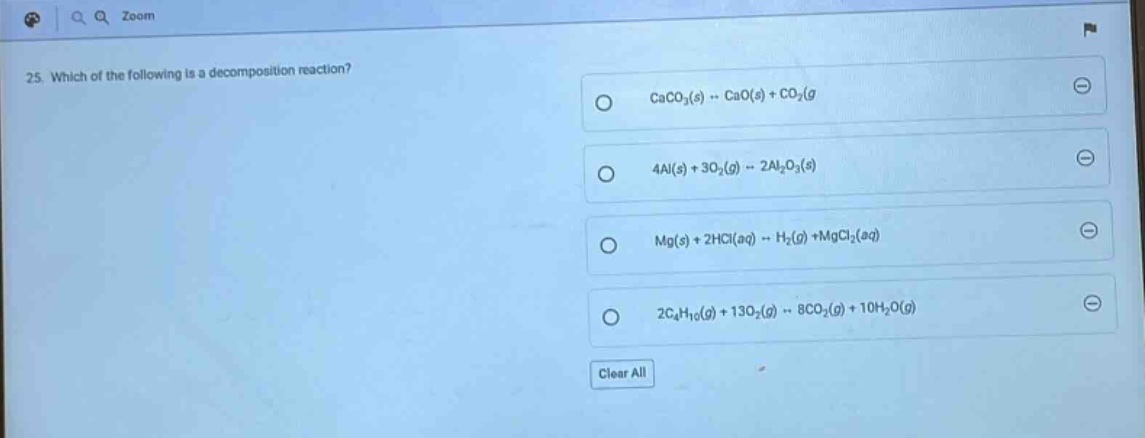
25. which of the following is a decomposition reaction?\ncaco₃(s) → cao(s) + co₂(g)\n4al(s) + 3o₂(g) → 2al₂o₃(s)\nmg(s) + 2hcl(aq) → h₂(g) + mgcl₂(aq)\n2c₄h₁₀(g) + 13o₂(g) → 8co₂(g) + 10h₂o(g)\nclear all
Answer
Brief Explanations:
A decomposition reaction is one where a single compound breaks down into two or more simpler substances. In the reaction $\ce{CaCO3(s)\rightarrow CaO(s) + CO2(g)}$, calcium - carbonate breaks down into calcium oxide and carbon - dioxide. The other reactions are a combination reaction ($4\ce{Al(s)}+3\ce{O2(g)}\rightarrow2\ce{Al2O3(s)}$), a single - displacement reaction ($\ce{Mg(s)} + 2\ce{HCl(aq)}\rightarrow\ce{H2(g)}+\ce{MgCl2(aq)}$) and a combustion reaction ($2\ce{C4H10(g)}+13\ce{O2(g)}\rightarrow8\ce{CO2(g)} + 10\ce{H2O(g)}$).
Answer:
$\ce{CaCO3(s)\rightarrow CaO(s) + CO2(g)}$