29. using the following equation, 2 naclo₃ → 2 nacl + 3 o₂, how many particles of naclo₃ are needed to…
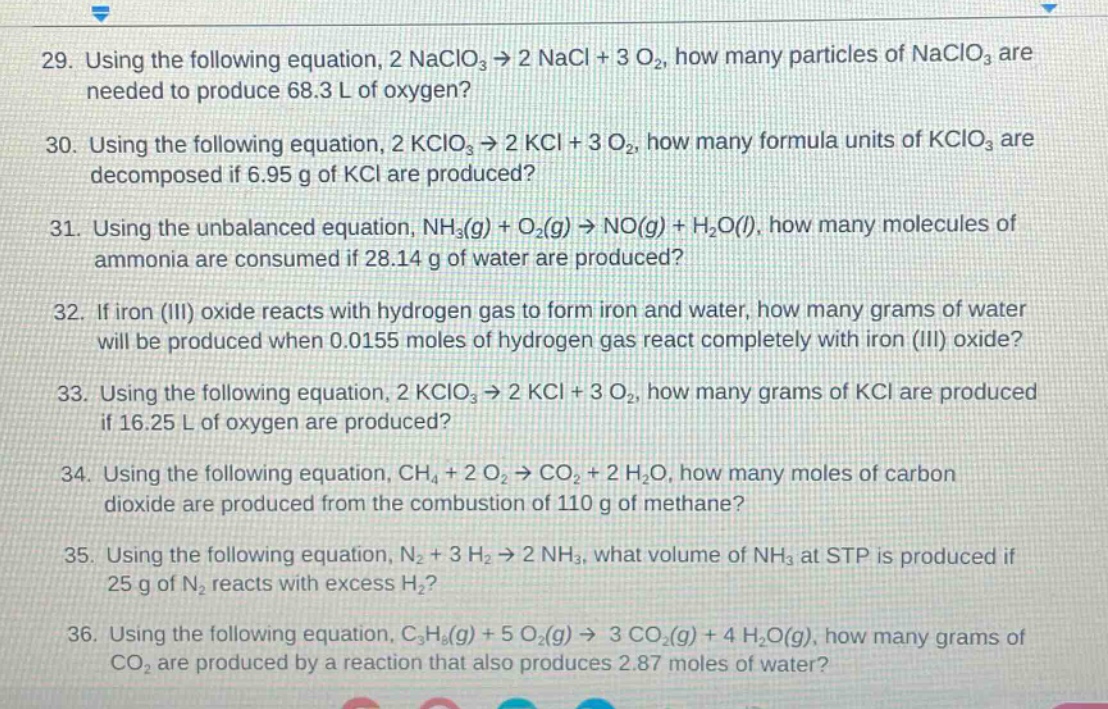
29. using the following equation, 2 naclo₃ → 2 nacl + 3 o₂, how many particles of naclo₃ are needed to produce 68.3 l of oxygen?\n30. using the following equation, 2 kclo₃ → 2 kcl + 3 o₂, how many formula units of kclo₃ are decomposed if 6.95 g of kcl are produced?\n31. using the unbalanced equation, nh₃(g) + o₂(g) → no(g) + h₂o(l), how many molecules of ammonia are consumed if 28.14 g of water are produced?\n32. if iron (iii) oxide reacts with hydrogen gas to form iron and water, how many grams of water will be produced when 0.0155 moles of hydrogen gas react completely with iron (iii) oxide?\n33. using the following equation, 2 kclo₃ → 2 kcl + 3 o₂, how many grams of kcl are produced if 16.25 l of oxygen are produced?\n34. using the following equation, ch₄ + 2 o₂ → co₂ + 2 h₂o, how many moles of carbon dioxide are produced from the combustion of 110 g of methane?\n35. using the following equation, n₂ + 3 h₂ → 2 nh₃, what volume of nh₃ at stp is produced if 25 g of n₂ reacts with excess h₂?\n36. using the following equation, c₃h₈(g) + 5 o₂(g) → 3 co₂(g) + 4 h₂o(g), how many grams of co₂ are produced by a reaction that also produces 2.87 moles of water?
Answer
29.
Explanation:
Step1: Find moles of O₂
At standard - temperature and pressure (STP), 1 mole of any gas occupies 22.4 L. So, the number of moles of O₂, $n_{O_2}=\frac{V}{V_m}$, where $V = 68.3$ L and $V_m=22.4$ L/mol. $n_{O_2}=\frac{68.3}{22.4}\text{ mol}\approx3.05$ mol
Step2: Use mole - ratio from the balanced equation
From the equation $2NaClO_3\rightarrow2NaCl + 3O_2$, the mole - ratio of $NaClO_3$ to $O_2$ is $\frac{2}{3}$. Let the number of moles of $NaClO_3$ be $n_{NaClO_3}$. Then $n_{NaClO_3}=\frac{2}{3}n_{O_2}$. $n_{NaClO_3}=\frac{2}{3}\times3.05\text{ mol}\approx2.03$ mol
Step3: Convert moles to particles
Using Avogadro's number $N_A = 6.022\times10^{23}$ particles/mol, the number of particles of $NaClO_3$, $N=n_{NaClO_3}\times N_A$. $N = 2.03\times6.022\times10^{23}\text{ particles}\approx1.22\times10^{24}$ particles
Answer:
$1.22\times10^{24}$ particles
30.
Explanation:
Step1: Calculate moles of KCl
The molar mass of KCl, $M_{KCl}=39.1 + 35.45=74.55$ g/mol. The number of moles of KCl, $n_{KCl}=\frac{m}{M}$, where $m = 6.95$ g. $n_{KCl}=\frac{6.95}{74.55}\text{ mol}\approx0.0932$ mol
Step2: Use mole - ratio from the balanced equation
From the equation $2KClO_3\rightarrow2KCl + 3O_2$, the mole - ratio of $KClO_3$ to $KCl$ is 1:1. So, the number of moles of $KClO_3$ decomposed, $n_{KClO_3}=n_{KCl}=0.0932$ mol.
Step3: Convert moles to formula units
Using Avogadro's number $N_A = 6.022\times10^{23}$ formula units/mol, the number of formula units of $KClO_3$, $N=n_{KClO_3}\times N_A$. $N = 0.0932\times6.022\times10^{23}\text{ formula units}\approx5.61\times10^{22}$ formula units
Answer:
$5.61\times10^{22}$ formula units
31.
Explanation:
Step1: Balance the equation
The balanced equation is $4NH_3(g)+5O_2(g)\rightarrow4NO(g)+6H_2O(l)$.
Step2: Calculate moles of water
The molar mass of $H_2O$, $M_{H_2O}=2\times1.01 + 16.00 = 18.02$ g/mol. The number of moles of $H_2O$, $n_{H_2O}=\frac{m}{M}$, where $m = 28.14$ g. $n_{H_2O}=\frac{28.14}{18.02}\text{ mol}\approx1.56$ mol
Step3: Use mole - ratio from the balanced equation
The mole - ratio of $NH_3$ to $H_2O$ is $\frac{4}{6}=\frac{2}{3}$. Let the number of moles of $NH_3$ be $n_{NH_3}$. Then $n_{NH_3}=\frac{2}{3}n_{H_2O}$. $n_{NH_3}=\frac{2}{3}\times1.56\text{ mol}=1.04$ mol
Step4: Convert moles to molecules
Using Avogadro's number $N_A = 6.022\times10^{23}$ molecules/mol, the number of molecules of $NH_3$, $N=n_{NH_3}\times N_A$. $N = 1.04\times6.022\times10^{23}\text{ molecules}\approx6.26\times10^{23}$ molecules
Answer:
$6.26\times10^{23}$ molecules
32.
Explanation:
Step1: Write the balanced equation
The balanced equation is $Fe_2O_3+3H_2\rightarrow2Fe + 3H_2O$.
Step2: Use mole - ratio from the balanced equation
The mole - ratio of $H_2$ to $H_2O$ is 1:1. Given $n_{H_2}=0.0155$ mol, so $n_{H_2O}=n_{H_2}=0.0155$ mol.
Step3: Calculate mass of water
The molar mass of $H_2O$, $M_{H_2O}=18.02$ g/mol. The mass of water, $m = n\times M$. $m=0.0155\times18.02\text{ g}\approx0.279$ g
Answer:
$0.279$ g
33.
Explanation:
Step1: Find moles of O₂
At STP, $n_{O_2}=\frac{V}{V_m}$, where $V = 16.25$ L and $V_m = 22.4$ L/mol. $n_{O_2}=\frac{16.25}{22.4}\text{ mol}\approx0.725$ mol
Step2: Use mole - ratio from the balanced equation
From the equation $2KClO_3\rightarrow2KCl + 3O_2$, the mole - ratio of $KCl$ to $O_2$ is $\frac{2}{3}$. Let the number of moles of $KCl$ be $n_{KCl}$. Then $n_{KCl}=\frac{2}{3}n_{O_2}$. $n_{KCl}=\frac{2}{3}\times0.725\text{ mol}\approx0.483$ mol
Step3: Calculate mass of KCl
The molar mass of $KCl$, $M_{KCl}=74.55$ g/mol. The mass of $KCl$, $m=n\times M$. $m = 0.483\times74.55\text{ g}\approx36.0$ g
Answer:
$36.0$ g
34.
Explanation:
Step1: Calculate moles of methane
The molar mass of $CH_4$, $M_{CH_4}=12.01+4\times1.01 = 16.05$ g/mol. The number of moles of $CH_4$, $n_{CH_4}=\frac{m}{M}$, where $m = 110$ g. $n_{CH_4}=\frac{110}{16.05}\text{ mol}\approx6.85$ mol
Step2: Use mole - ratio from the balanced equation
From the equation $CH_4+2O_2\rightarrow CO_2 + 2H_2O$, the mole - ratio of $CH_4$ to $CO_2$ is 1:1. So, the number of moles of $CO_2$, $n_{CO_2}=n_{CH_4}=6.85$ mol
Answer:
$6.85$ mol
35.
Explanation:
Step1: Calculate moles of N₂
The molar mass of $N_2$, $M_{N_2}=2\times14.01 = 28.02$ g/mol. The number of moles of $N_2$, $n_{N_2}=\frac{m}{M}$, where $m = 25$ g. $n_{N_2}=\frac{25}{28.02}\text{ mol}\approx0.892$ mol
Step2: Use mole - ratio from the balanced equation
From the equation $N_2+3H_2\rightarrow2NH_3$, the mole - ratio of $N_2$ to $NH_3$ is 1:2. So, the number of moles of $NH_3$, $n_{NH_3}=2n_{N_2}$. $n_{NH_3}=2\times0.892\text{ mol}=1.784$ mol
Step3: Calculate volume of NH₃ at STP
At STP, $V = n\times V_m$, where $V_m = 22.4$ L/mol. $V=1.784\times22.4\text{ L}\approx40.0$ L
Answer:
$40.0$ L
36.
Explanation:
Step1: Use mole - ratio from the balanced equation
From the equation $C_3H_8(g)+5O_2(g)\rightarrow3CO_2(g)+4H_2O(g)$, the mole - ratio of $CO_2$ to $H_2O$ is $\frac{3}{4}$. Given $n_{H_2O}=2.87$ mol. Let the number of moles of $CO_2$ be $n_{CO_2}$. Then $n_{CO_2}=\frac{3}{4}n_{H_2O}$. $n_{CO_2}=\frac{3}{4}\times2.87\text{ mol}=2.1525$ mol
Step2: Calculate mass of CO₂
The molar mass of $CO_2$, $M_{CO_2}=12.01+2\times16.00 = 44.01$ g/mol. The mass of $CO_2$, $m=n\times M$. $m=2.1525\times44.01\text{ g}\approx94.7$ g
Answer:
$94.7$ g