2co(g) + o₂(g) → 2co₂(g)\nif the reaction occurs in a closed chamber, ____________ will result in a decrease…
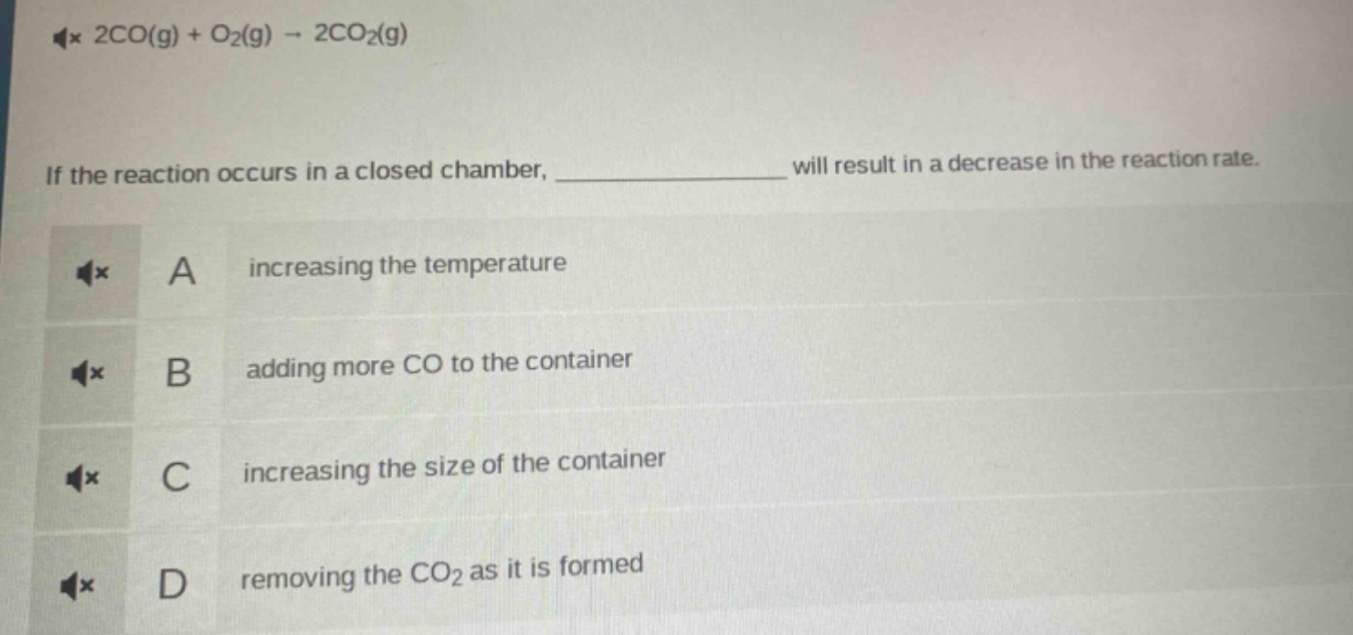
2co(g) + o₂(g) → 2co₂(g)\nif the reaction occurs in a closed chamber, ____________ will result in a decrease in the reaction rate.\na increasing the temperature\nb adding more co to the container\nc increasing the size of the container\nd removing the co₂ as it is formed
Answer
Explanation:
Step1: Recall reaction - rate factors
Reaction rate depends on concentration, temperature, etc. Higher concentration and temperature usually increase reaction rate.
Step2: Analyze option A
Increasing temperature provides more kinetic energy to reactant molecules, increasing collision frequency and reaction rate. So A is incorrect.
Step3: Analyze option B
Adding more CO (a reactant) increases its concentration. Higher reactant concentration leads to more collisions and higher reaction rate. So B is incorrect.
Step4: Analyze option C
Increasing the size of the container decreases the pressure (for gas - phase reactions like this one). Decreased pressure means lower concentration of reactants (fewer molecules per unit volume), resulting in fewer collisions and a lower reaction rate. So C is correct.
Step5: Analyze option D
Removing CO₂ as it is formed shifts the equilibrium to the right according to Le - Chatelier's principle. This can potentially increase the forward reaction rate as the system tries to re - establish equilibrium. So D is incorrect.
Answer:
C. increasing the size of the container