x(g) + 2y(g) ⇌ z(g) k_c = 2.7×10^6 at 298 k\nat 298 k, a 2.0 mol sample of x(g) and a 2.0 mol sample of y(g)…
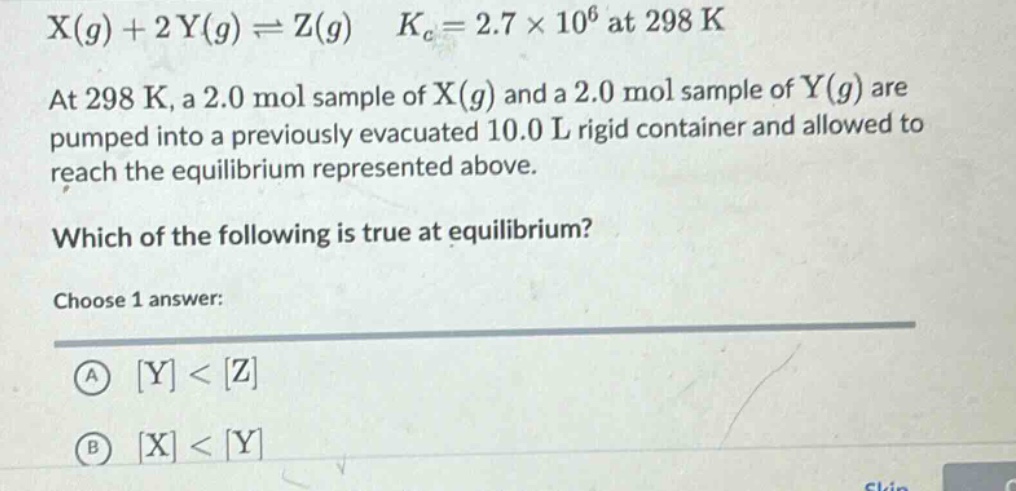
x(g) + 2y(g) ⇌ z(g) k_c = 2.7×10^6 at 298 k\nat 298 k, a 2.0 mol sample of x(g) and a 2.0 mol sample of y(g) are pumped into a previously evacuated 10.0 l rigid container and allowed to reach the equilibrium represented above.\nwhich of the following is true at equilibrium?\nchoose 1 answer:\na y < z\nb x < y
Answer
Explanation:
Step1: Calculate initial concentrations
Initial concentration of $X$, $[X]_0=\frac{2.0\ mol}{10.0\ L} = 0.2\ M$; initial concentration of $Y$, $[Y]_0=\frac{2.0\ mol}{10.0\ L}=0.2\ M$; initial concentration of $Z$, $[Z]_0 = 0\ M$.
Step2: Set up the ICE - table
Let the change in concentration of $X$ be $x\ M$. Then the change in concentration of $Y$ is $2x\ M$ and the change in concentration of $Z$ is $x\ M$. At equilibrium, $[X]=0.2 - x$, $[Y]=0.2 - 2x$, $[Z]=x$.
Step3: Write the equilibrium - constant expression
The equilibrium - constant expression for the reaction $X(g)+2Y(g)\rightleftharpoons Z(g)$ is $K_c=\frac{[Z]}{[X][Y]^2}$. Given $K_c = 2.7\times10^{6}$. Since $K_c$ is very large ($K_c\gg1$), the reaction proceeds almost to completion. So, we assume that $0.2 - 2x\approx0$ (because the reaction goes far to the right), then $x\approx0.1$. At equilibrium, $[X]=0.2 - x\approx0.1$, $[Y]\approx0$, $[Z]\approx0.1$.
Answer:
A. $[Y]<[Z]$