3cu²⁺ + 2cr → 2cr³⁺ + 3cu\nwhich of these represents the line notation of the spontaneous cell?\na. cu |…
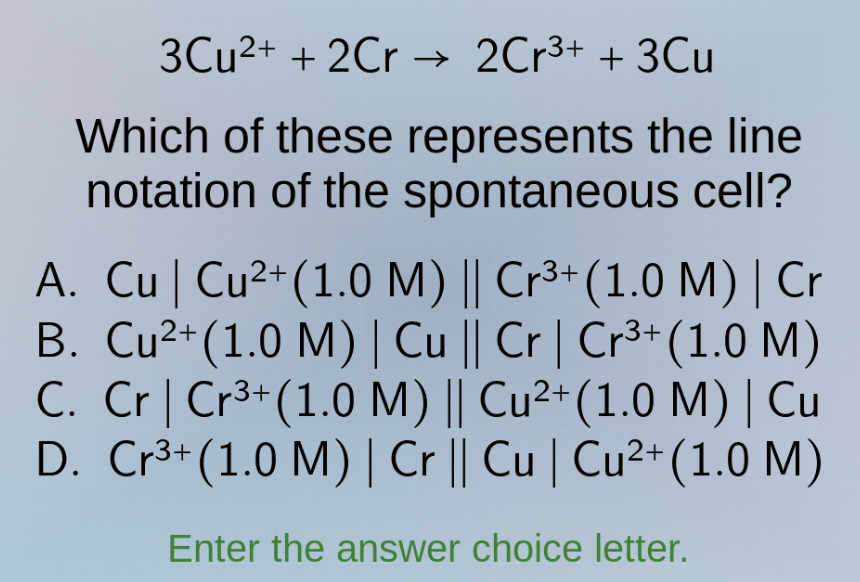
3cu²⁺ + 2cr → 2cr³⁺ + 3cu\nwhich of these represents the line notation of the spontaneous cell?\na. cu | cu²⁺(1.0 m) || cr³⁺(1.0 m) | cr\nb. cu²⁺(1.0 m) | cu || cr | cr³⁺(1.0 m)\nc. cr | cr³⁺(1.0 m) || cu²⁺(1.0 m) | cu\nd. cr³⁺(1.0 m) | cr || cu | cu²⁺(1.0 m)\nenter the answer choice letter.
Answer
Brief Explanations:
- First, identify the oxidation and reduction half - reactions from the given redox reaction (3Cu^{2+}+2Cr\rightarrow2Cr^{3+}+3Cu).
- Oxidation is the loss of electrons. For (Cr), the reaction is (Cr\rightarrow Cr^{3+}+3e^-) (oxidation, anode reaction).
- Reduction is the gain of electrons. For (Cu^{2+}), the reaction is (Cu^{2+}+2e^-\rightarrow Cu) (reduction, cathode reaction).
- In line notation, the anode (where oxidation occurs) is written on the left, and the cathode (where reduction occurs) is written on the right. The anode is (Cr) (undergoing oxidation to (Cr^{3+})) and the cathode is (Cu^{2+}) (undergoing reduction to (Cu)). So the line notation should have (Cr|Cr^{3 +}(1.0 M)||Cu^{2+}(1.0 M)|Cu).