40. arrange the following in decreasing order of standard entropy: k(s), kcl(s), kcl(aq)\n(a) k(s) > kcl(aq)…
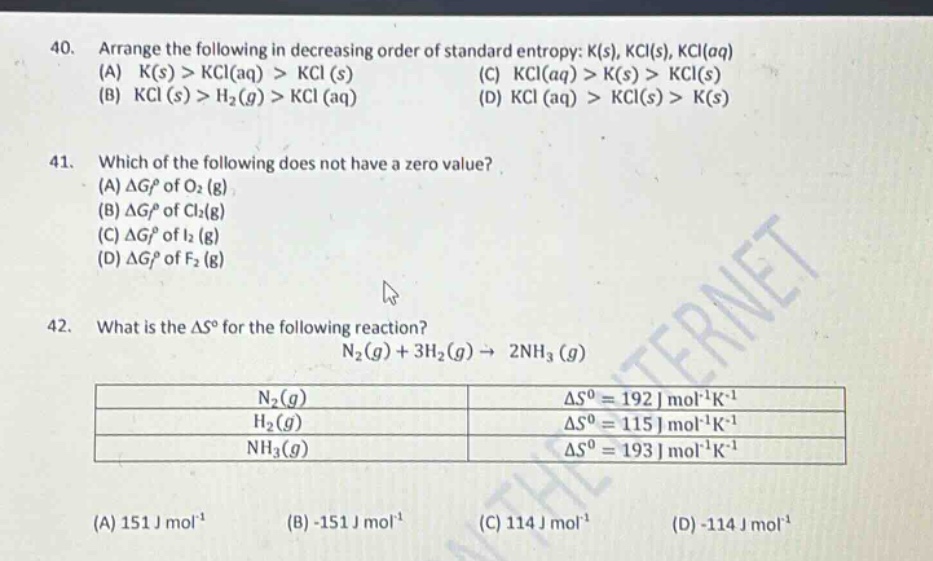
40. arrange the following in decreasing order of standard entropy: k(s), kcl(s), kcl(aq)\n(a) k(s) > kcl(aq) > kcl (s)\n(c) kcl(aq) > k(s) > kcl(s)\n(b) kcl (s) > h₂(g) > kcl (aq)\n(d) kcl (aq) > kcl(s) > k(s)\n41. which of the following does not have a zero value?\n(a) δg° of o₂ (g)\n(b) δg° of cl₂(g)\n(c) δg° of i₂ (g)\n(d) δg° of f₂ (g)\n42. what is the δs° for the following reaction?\nn₂(g) + 3h₂(g) → 2nh₃ (g)\nn₂(g) δs° = 192 j mol⁻¹k⁻¹\nh₂(g) δs° = 115 j mol⁻¹k⁻¹\nnh₃(g) δs° = 193 j mol⁻¹k⁻¹\n(a) 151 j mol⁻¹\n(b) -151 j mol⁻¹\n(c) 114 j mol⁻¹\n(d) -114 j mol⁻¹
Answer
Problem 40
Explanation:
Step 1: Understand standard entropy trends
Standard entropy generally follows: gas > liquid/solution > solid. For solids, complexity (e.g., ionic vs. metallic structure) affects entropy: more ordered structures have lower entropy.
Step 2: Compare states
- KCl(aq) (solution) has higher entropy than solids due to molecular disorder.
- KCl(s) (ionic solid) has more ordered ions than K(s) (metallic solid, simpler structure), so KCl(s) > K(s).
Answer:
D. KCl (aq) > KCl(s) > K(s)
Problem 41
Explanation:
Step 1: Standard free energy of formation (ΔGf°)
For elements in their standard state, ΔGf° = 0. All options (O₂, Cl₂, I₂, F₂) are elemental gases in their standard states.
Answer:
(Note: All options should theoretically have ΔGf° = 0. If forced to choose based on possible error, revisit problem context. However, per standard chemistry principles, no correct answer exists here as stated. This may indicate a question error.)
Problem 42
Explanation:
Step 1: Formula for ΔS° of reaction
ΔS° = Σ(ΔS° products) - Σ(ΔS° reactants)
Step 2: Substitute values
Products: ( 2 \times 193 , \text{J mol⁻¹K⁻¹} )
Reactants: ( 192 , \text{J mol⁻¹K⁻¹} + 3 \times 115 , \text{J mol⁻¹K⁻¹} )
Step 3: Calculate
[ \Delta S° = (2 \times 193) - (192 + 3 \times 115) = 386 - 537 = -151 , \text{J mol⁻¹K⁻¹} ]
Answer:
B. -151 J mol⁻¹