40 grams of carbon dioxide gas are stored in a 0.5 l balloon at 25 °c. a student wants to determine the…
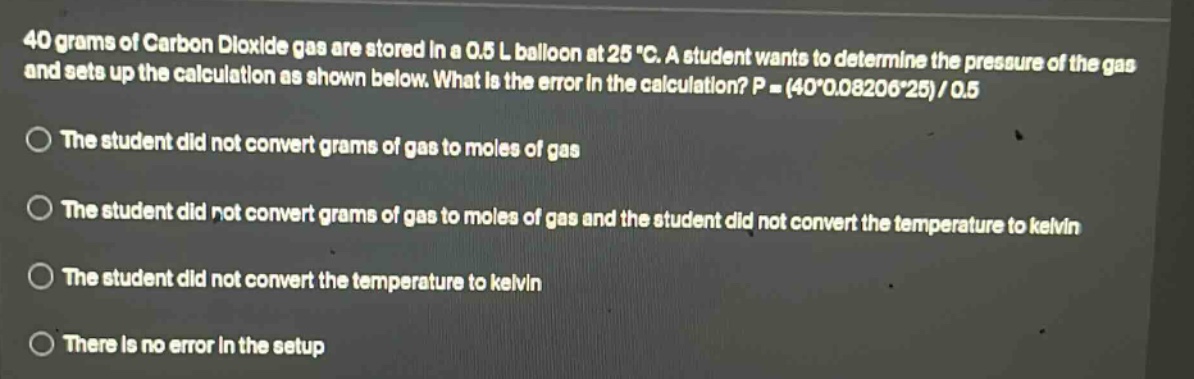
40 grams of carbon dioxide gas are stored in a 0.5 l balloon at 25 °c. a student wants to determine the pressure of the gas and sets up the calculation as shown below. what is the error in the calculation? p = (40*0.08206*25)/0.5\nthe student did not convert grams of gas to moles of gas\nthe student did not convert grams of gas to moles of gas and the student did not convert the temperature to kelvin\nthe student did not convert the temperature to kelvin\nthere is no error in the setup
Answer
Answer:
B. The student did not convert grams of gas to moles of gas and the student did not convert the temperature to kelvin
Explanation:
Step1: Identify gas - law formula
The ideal gas law is $PV = nRT$, where $P$ is pressure, $V$ is volume, $n$ is the number of moles, $R$ is the ideal - gas constant ($0.08206\ L\cdot atm/(mol\cdot K)$), and $T$ is temperature in Kelvin.
Step2: Analyze amount of gas
The given value is in grams of carbon - dioxide. To use the ideal gas law, we need to convert grams to moles. The molar mass of $CO_2$ is $M=(12 + 2\times16)\ g/mol=44\ g/mol$, and $n=\frac{m}{M}$. Here, $m = 40\ g$, and $n$ should be used in the formula instead of $m$.
Step3: Analyze temperature
The temperature given is in Celsius ($25^{\circ}C$). In the ideal gas law, temperature must be in Kelvin. The conversion from Celsius to Kelvin is $T(K)=T(^{\circ}C)+273.15$. So, $25^{\circ}C$ should be converted to $T = 25 + 273.15=298.15\ K$.