0.50 g of mg reacts with excess oxygen in a bomb calorimeter. the overall heat capacity, including both the…
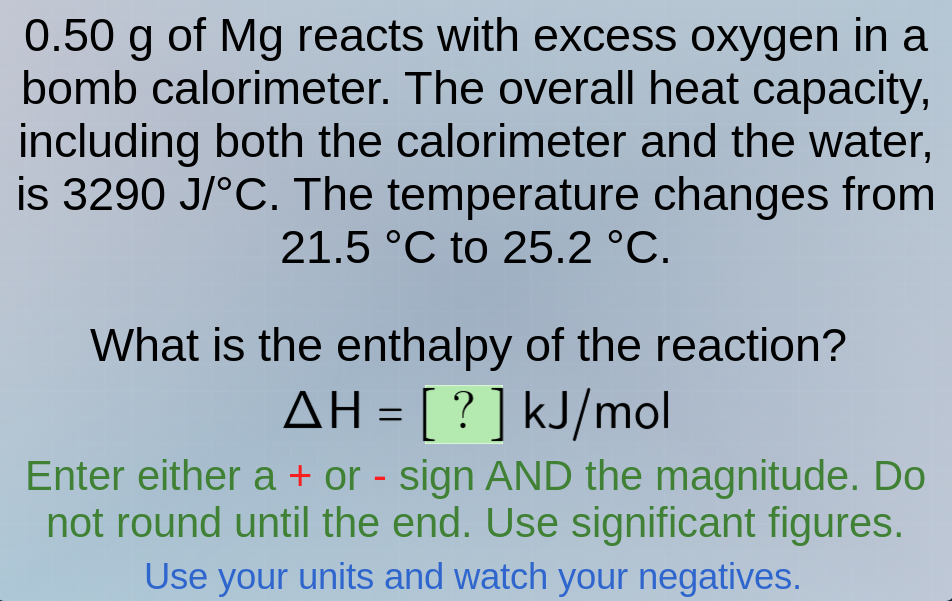
0.50 g of mg reacts with excess oxygen in a bomb calorimeter. the overall heat capacity, including both the calorimeter and the water, is 3290 j/°c. the temperature changes from 21.5 °c to 25.2 °c. what is the enthalpy of the reaction? δh = ? kj/mol enter either a + or - sign and the magnitude. do not round until the end. use significant figures. use your units and watch your negatives.
Answer
Explanation:
Step1: Calculate heat absorbed by calorimeter
The heat absorbed by the calorimeter ((q_{cal})) is given by (q_{cal}=C\Delta T), where (C = 3290\ J/^\circ C) and (\Delta T=T_2 - T_1=25.2^\circ C - 21.5^\circ C = 3.7^\circ C). So, (q_{cal}=3290\ J/^\circ C\times3.7^\circ C = 12173\ J).
Step2: Determine heat of reaction ((q_{rxn}))
For a bomb calorimeter, the heat released by the reaction ((q_{rxn})) is equal in magnitude but opposite in sign to the heat absorbed by the calorimeter. So, (q_{rxn}=-q_{cal}=- 12173\ J=-12.173\ kJ) (converted to kJ by dividing by 1000).
Step3: Calculate moles of Mg
The molar mass of Mg is (24.305\ g/mol). Moles of Mg ((n)) is given by (n=\frac{mass}{molar\ mass}=\frac{0.50\ g}{24.305\ g/mol}\approx0.02057\ mol).
Step4: Calculate enthalpy change ((\Delta H))
Enthalpy change is given by (\Delta H=\frac{q_{rxn}}{n}). Substituting the values, (\Delta H=\frac{- 12.173\ kJ}{0.02057\ mol}\approx - 591.7\ kJ/mol).
Answer:
(-592) (rounded to three significant figures, the original calculation gives approximately - 591.7 which rounds to - 592)