4.5q-percent composition to empirical molecular formula\nmust show work for each problem.\n1. a pure…
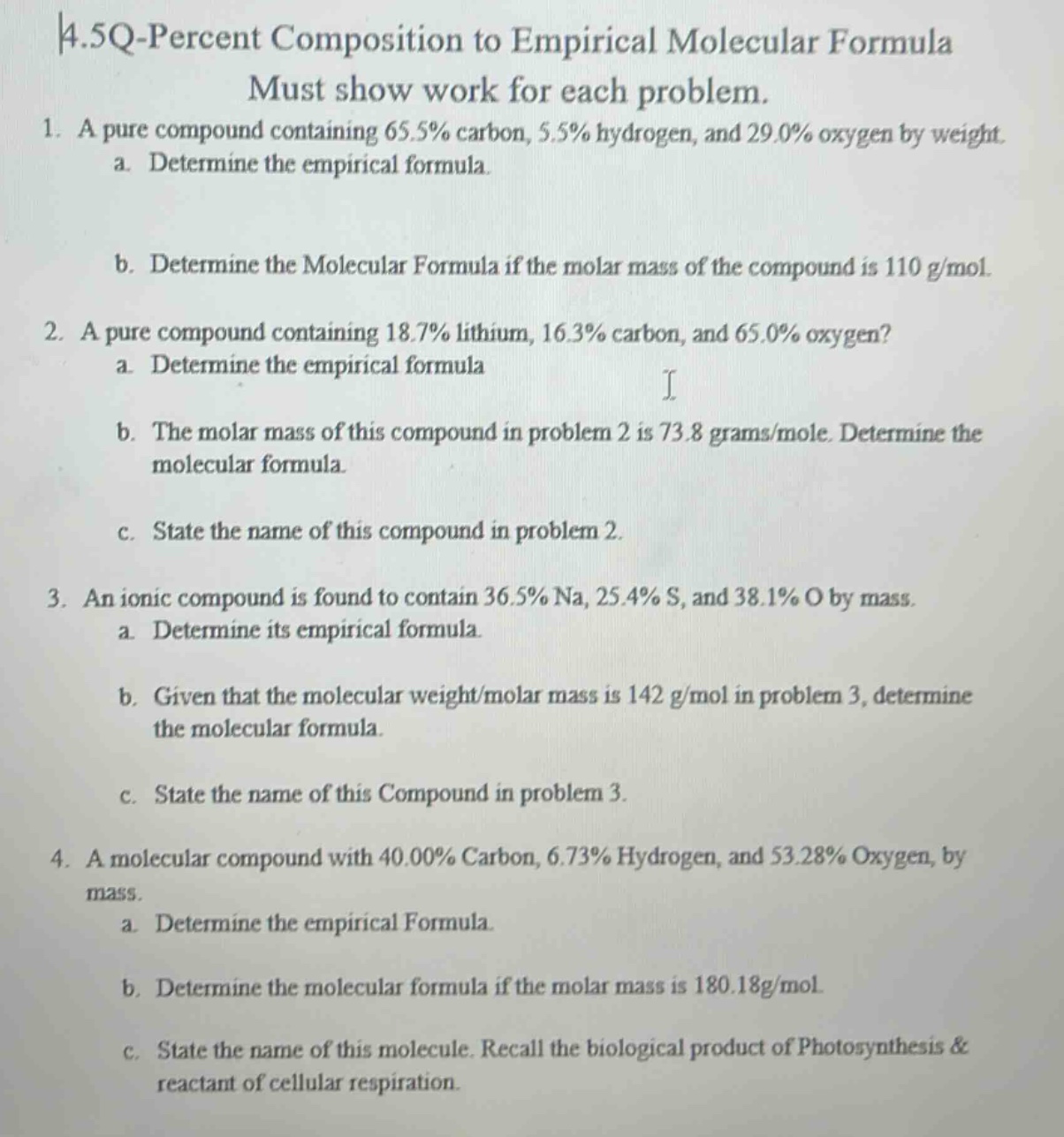
4.5q-percent composition to empirical molecular formula\nmust show work for each problem.\n1. a pure compound containing 65.5% carbon, 5.5% hydrogen, and 29.0% oxygen by weight.\n a. determine the empirical formula.\n b. determine the molecular formula if the molar mass of the compound is 110 g/mol.\n2. a pure compound containing 18.7% lithium, 16.3% carbon, and 65.0% oxygen?\n a. determine the empirical formula\n b. the molar mass of this compound in problem 2 is 73.8 grams/mole. determine the molecular formula.\n c. state the name of this compound in problem 2.\n3. an ionic compound is found to contain 36.5% na, 25.4% s, and 38.1% o by mass.\n a. determine its empirical formula.\n b. given that the molecular weight/molar mass is 142 g/mol in problem 3, determine the molecular formula.\n c. state the name of this compound in problem 3.\n4. a molecular compound with 40.00% carbon, 6.73% hydrogen, and 53.28% oxygen, by mass.\n a. determine the empirical formula.\n b. determine the molecular formula if the molar mass is 180.18g/mol.\n c. state the name of this molecule. recall the biological product of photosynthesis & reactant of cellular respiration.
Answer
Problem 1
a. Determine the empirical formula
Explanation:
Step1: Assume 100g of the compound
The masses of C, H, and O are 65.5g, 5.5g, and 29.0g respectively.
Step2: Calculate the moles of each element
Moles of C: $n_{C}=\frac{65.5g}{12.01g/mol}\approx5.45mol$ Moles of H: $n_{H}=\frac{5.5g}{1.01g/mol}\approx5.45mol$ Moles of O: $n_{O}=\frac{29.0g}{16.00g/mol}\approx1.81mol$
Step3: Find the mole - ratio
Divide each number of moles by the smallest number of moles (1.81mol). Ratio of C: $\frac{5.45mol}{1.81mol}\approx3$ Ratio of H: $\frac{5.45mol}{1.81mol}\approx3$ Ratio of O: $\frac{1.81mol}{1.81mol}=1$ The empirical formula is $C_{3}H_{3}O$.
b. Determine the molecular formula
Explanation:
Step1: Calculate the empirical - formula mass
Empirical - formula mass of $C_{3}H_{3}O=(3\times12.01 + 3\times1.01+16.00)g/mol=(36.03 + 3.03+16.00)g/mol = 55.06g/mol$
Step2: Find the multiple 'n'
$n=\frac{\text{Molar mass}}{\text{Empirical - formula mass}}=\frac{110g/mol}{55.06g/mol}\approx2$
Step3: Determine the molecular formula
Molecular formula = $(C_{3}H_{3}O)2 = C{6}H_{6}O_{2}$
Problem 2
a. Determine the empirical formula
Explanation:
Step1: Assume 100g of the compound
The masses of Li, C, and O are 18.7g, 16.3g, and 65.0g respectively.
Step2: Calculate the moles of each element
Moles of Li: $n_{Li}=\frac{18.7g}{6.94g/mol}\approx2.7mol$ Moles of C: $n_{C}=\frac{16.3g}{12.01g/mol}\approx1.36mol$ Moles of O: $n_{O}=\frac{65.0g}{16.00g/mol}\approx4.06mol$
Step3: Find the mole - ratio
Divide each number of moles by the smallest number of moles (1.36mol). Ratio of Li: $\frac{2.7mol}{1.36mol}\approx2$ Ratio of C: $\frac{1.36mol}{1.36mol}=1$ Ratio of O: $\frac{4.06mol}{1.36mol}\approx3$ The empirical formula is $Li_{2}CO_{3}$.
b. Determine the molecular formula
Explanation:
Step1: Calculate the empirical - formula mass
Empirical - formula mass of $Li_{2}CO_{3}=(2\times6.94 + 12.01+3\times16.00)g/mol=(13.88 + 12.01 + 48.00)g/mol=73.89g/mol$
Step2: Find the multiple 'n'
$n=\frac{\text{Molar mass}}{\text{Empirical - formula mass}}=\frac{73.8g/mol}{73.89g/mol}\approx1$
Step3: Determine the molecular formula
Molecular formula = $Li_{2}CO_{3}$
c. State the name of this compound
Answer:
Lithium carbonate
Problem 3
a. Determine the empirical formula
Explanation:
Step1: Assume 100g of the compound
The masses of Na, S, and O are 36.5g, 25.4g, and 38.1g respectively.
Step2: Calculate the moles of each element
Moles of Na: $n_{Na}=\frac{36.5g}{22.99g/mol}\approx1.59mol$ Moles of S: $n_{S}=\frac{25.4g}{32.07g/mol}\approx0.79mol$ Moles of O: $n_{O}=\frac{38.1g}{16.00g/mol}\approx2.38mol$
Step3: Find the mole - ratio
Divide each number of moles by the smallest number of moles (0.79mol). Ratio of Na: $\frac{1.59mol}{0.79mol}\approx2$ Ratio of S: $\frac{0.79mol}{0.79mol}=1$ Ratio of O: $\frac{2.38mol}{0.79mol}\approx3$ The empirical formula is $Na_{2}SO_{3}$.
b. Determine the molecular formula
Explanation:
Step1: Calculate the empirical - formula mass
Empirical - formula mass of $Na_{2}SO_{3}=(2\times22.99+32.07 + 3\times16.00)g/mol=(45.98+32.07 + 48.00)g/mol = 126.05g/mol$
Step2: Find the multiple 'n'
$n=\frac{\text{Molar mass}}{\text{Empirical - formula mass}}=\frac{142g/mol}{126.05g/mol}\approx1$
Step3: Determine the molecular formula
Molecular formula = $Na_{2}SO_{3}$
c. State the name of this compound
Answer:
Sodium sulfite
Problem 4
a. Determine the empirical formula
Explanation:
Step1: Assume 100g of the compound
The masses of C, H, and O are 40.00g, 6.73g, and 53.28g respectively.
Step2: Calculate the moles of each element
Moles of C: $n_{C}=\frac{40.00g}{12.01g/mol}\approx3.33mol$ Moles of H: $n_{H}=\frac{6.73g}{1.01g/mol}\approx6.66mol$ Moles of O: $n_{O}=\frac{53.28g}{16.00g/mol}\approx3.33mol$
Step3: Find the mole - ratio
Divide each number of moles by the smallest number of moles (3.33mol). Ratio of C: $\frac{3.33mol}{3.33mol}=1$ Ratio of H: $\frac{6.66mol}{3.33mol}=2$ Ratio of O: $\frac{3.33mol}{3.33mol}=1$ The empirical formula is $CH_{2}O$.
b. Determine the molecular formula
Explanation:
Step1: Calculate the empirical - formula mass
Empirical - formula mass of $CH_{2}O=(12.01+2\times1.01 + 16.00)g/mol=(12.01+2.02+16.00)g/mol = 30.03g/mol$
Step2: Find the multiple 'n'
$n=\frac{\text{Molar mass}}{\text{Empirical - formula mass}}=\frac{180.18g/mol}{30.03g/mol}=6$
Step3: Determine the molecular formula
Molecular formula = $(CH_{2}O)6 = C{6}H_{12}O_{6}$
c. State the name of this molecule
Answer:
Glucose