aa(aq) + bb(aq) ⇌ cc(aq) + dd(aq)\naccording to le chateliers principle, which statement correctly completes…
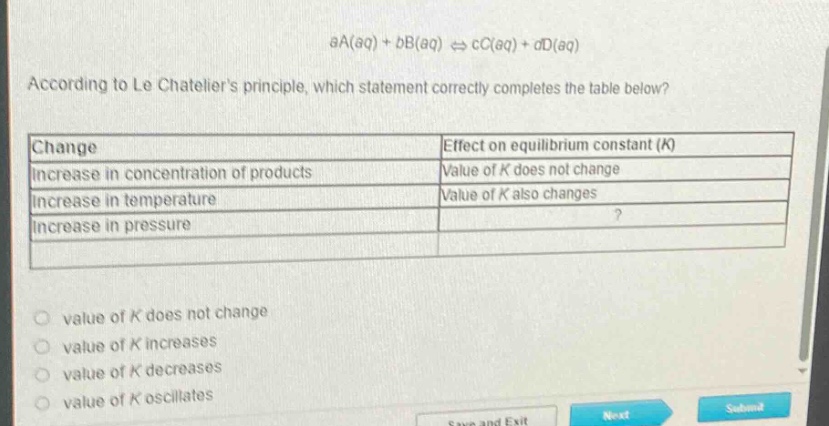
aa(aq) + bb(aq) ⇌ cc(aq) + dd(aq)\naccording to le chateliers principle, which statement correctly completes the table below?\n|change|effect on equilibrium constant (k)|\n|--|--|\n|increase in concentration of products|value of k does not change|\n|increase in temperature|value of k also changes|\n|increase in pressure|?|\n\nvalue of k does not change\nvalue of k increases\nvalue of k decreases\nvalue of k oscillates
Answer
Answer:
value of $K$ does not change
Explanation:
Step1: Recall Le - Chatelier's principle
The equilibrium constant ($K$) is only affected by temperature for a given chemical reaction.
Step2: Analyze effect of pressure
Changing the pressure of a system at equilibrium (for reactions involving gases) will shift the position of the equilibrium to counter - act the change, but it does not change the value of the equilibrium constant $K$. This is because the ratio of the concentrations (or partial pressures for gases) of products to reactants at equilibrium, which defines $K$, remains the same as long as the temperature is constant.