$aa(aq) + bb(aq) \\rightleftharpoons cc(aq) + dd(aq)$\n\naccording to le chateliers principle, which…
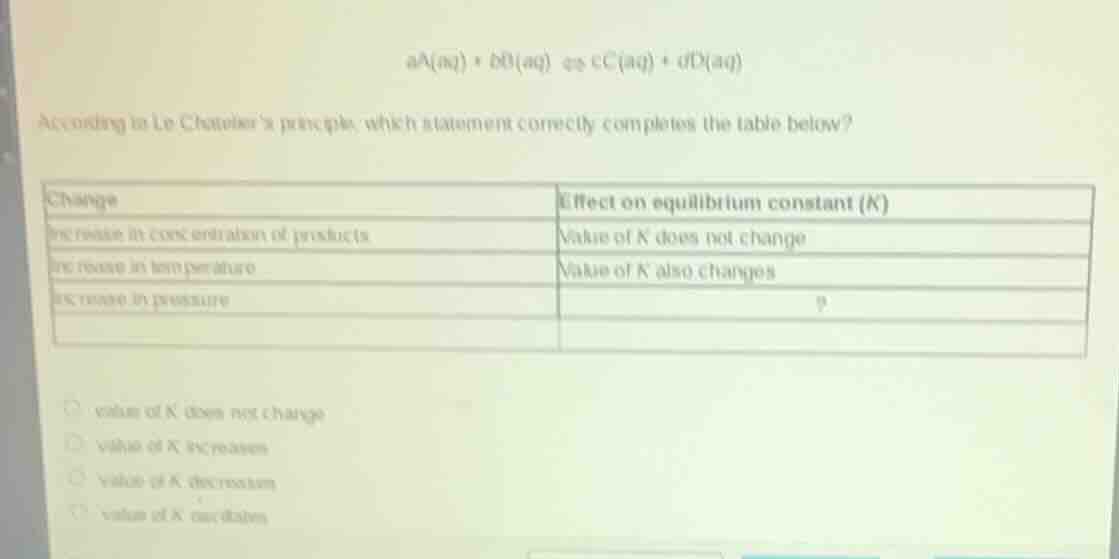
$aa(aq) + bb(aq) \\rightleftharpoons cc(aq) + dd(aq)$\n\naccording to le chateliers principle, which statement correctly completes the table below?\n\n| change | effect on equilibrium constant (k) |\n| :--- | :--- |\n| increase in concentration of products | value of k does not change |\n| increase in temperature | value of k also changes |\n| increase in pressure | ? |\n\n- value of k does not change\n- value of k increases\n- value of k decreases\n- value of k oscillates
Answer
Explanation:
Step1: Define the equilibrium constant
The equilibrium constant $K$ is a ratio of product concentrations to reactant concentrations at equilibrium for a specific temperature.
Step2: Identify factors affecting $K$
According to Le Chatelier's principle, the value of the equilibrium constant $K$ is temperature-dependent only.
Step3: Analyze the effect of pressure
Changes in pressure or concentration may shift the equilibrium position, but they do not alter the numerical value of $K$.
Step4: Determine the correct statement
Since pressure does not affect the constant, the value of $K$ remains constant when pressure increases.
Answer:
value of K does not change