according to the octet rule, would potassium be more likely to gain or lose electrons to achieve a full…
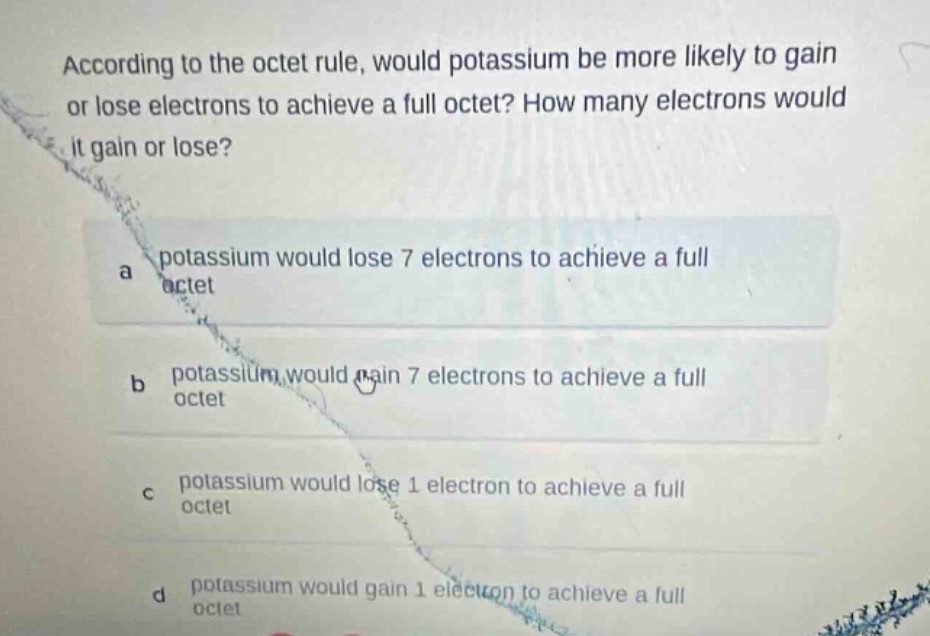
according to the octet rule, would potassium be more likely to gain or lose electrons to achieve a full octet? how many electrons would it gain or lose?\na potassium would lose 7 electrons to achieve a full octet\nb potassium would gain 7 electrons to achieve a full octet\nc potassium would lose 1 electron to achieve a full octet\nd potassium would gain 1 electron to achieve a full octet
Answer
Explanation:
Step1: Identify potassium's electron - configuration
Potassium (K) has an atomic number of 19. Its electron - configuration is 2, 8, 8, 1.
Step2: Apply the octet rule
The octet rule states that atoms tend to gain, lose, or share electrons to have 8 electrons in their outermost shell. Potassium has 1 electron in its outermost shell. It is easier for potassium to lose 1 electron to achieve a stable electron - configuration of 2, 8, 8 (a full outer shell of 8 electrons), rather than gain 7 electrons.
Answer:
C. potassium would lose 1 electron to achieve a full octet