9) an acid commonly used in the automotive industry is shown to be 31.6% phosphorous, 3.1% hydrogen, and…
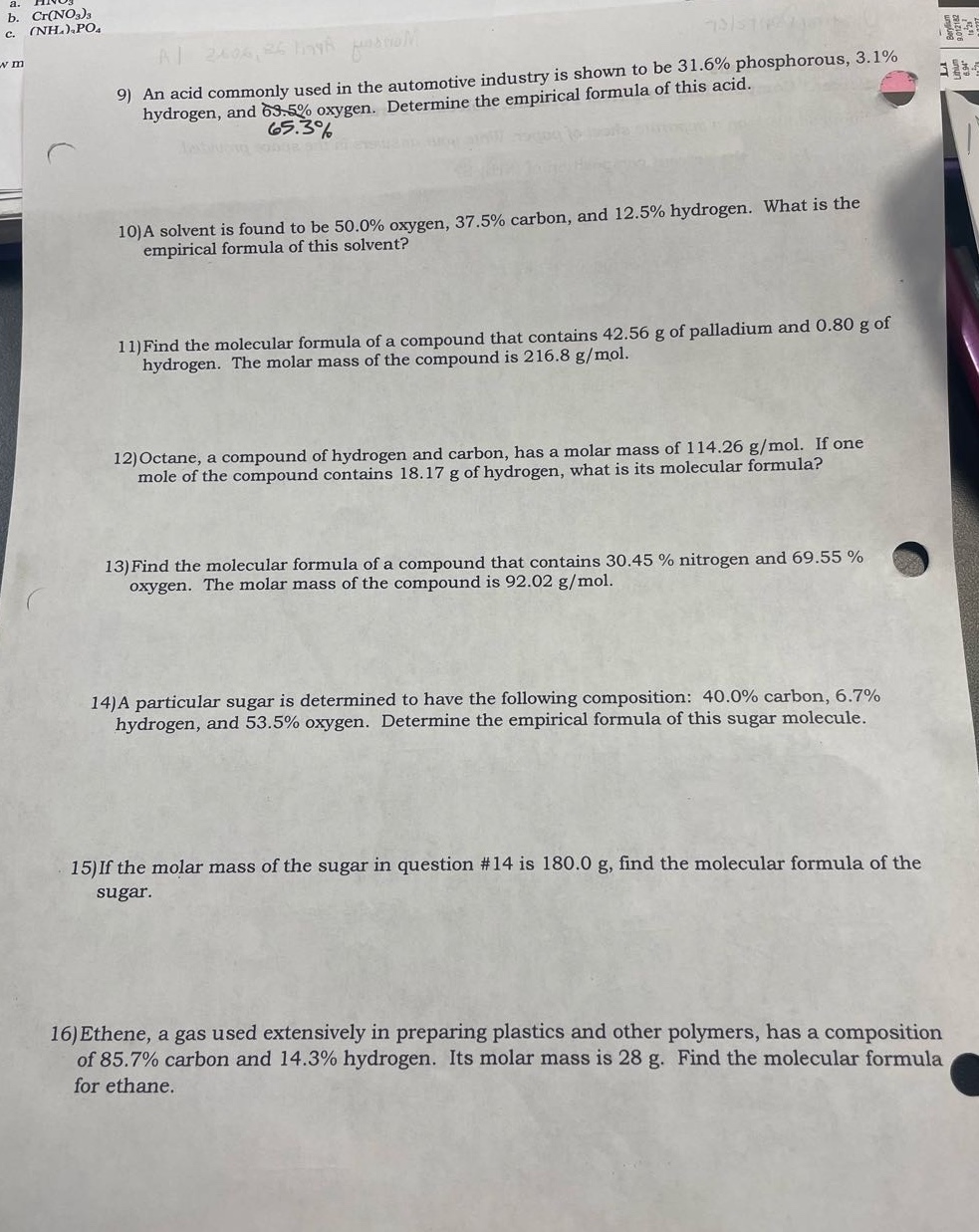
9) an acid commonly used in the automotive industry is shown to be 31.6% phosphorous, 3.1% hydrogen, and 65.3% oxygen. determine the empirical formula of this acid.\n10)a solvent is found to be 50.0% oxygen, 37.5% carbon, and 12.5% hydrogen. what is the empirical formula of this solvent?\n11)find the molecular formula of a compound that contains 42.56 g of palladium and 0.80 g of hydrogen. the molar mass of the compound is 216.8 g/mol.\n12)octane, a compound of hydrogen and carbon, has a molar mass of 114.26 g/mol. if one mole of the compound contains 18.17 g of hydrogen, what is its molecular formula?\n13)find the molecular formula of a compound that contains 30.45 % nitrogen and 69.55 % oxygen. the molar mass of the compound is 92.02 g/mol.\n14)a particular sugar is determined to have the following composition: 40.0% carbon, 6.7% hydrogen, and 53.5% oxygen. determine the empirical formula of this sugar molecule.\n15)if the molar mass of the sugar in question #14 is 180.0 g, find the molecular formula of the sugar.\n16)ethene, a gas used extensively in preparing plastics and other polymers, has a composition of 85.7% carbon and 14.3% hydrogen. its molar mass is 28 g. find the molecular formula for ethane.
Answer
Explanation:
Step1: Assume 100 g of the compound
This allows us to convert mass - percentages to masses directly. For example, if a compound is 30% A and 70% B by mass, in 100 g of the compound, there are 30 g of A and 70 g of B.
Step2: Calculate the number of moles of each element
Use the formula $n=\frac{m}{M}$, where $n$ is the number of moles, $m$ is the mass, and $M$ is the molar - mass. The molar - mass of $H = 1.01\ g/mol$, $C = 12.01\ g/mol$, $N=14.01\ g/mol$, $O = 16.00\ g/mol$, $P = 30.97\ g/mol$, $Pd=106.42\ g/mol$.
Step3: Find the mole - ratio of the elements
Divide the number of moles of each element by the smallest number of moles among them to get the sub - scripts in the empirical formula.
Step4: Determine the molecular formula (if required)
First, find the empirical formula mass ($EFM$). Then, calculate the ratio $n=\frac{M}{EFM}$, where $M$ is the molar mass of the compound. Multiply the sub - scripts of the empirical formula by $n$ to get the molecular formula.
Problem 9
Assume 100 g of the acid. Then $m_P = 31.6\ g$, $m_H=3.1\ g$, $m_O = 65.3\ g$. $n_P=\frac{31.6\ g}{30.97\ g/mol}\approx1.02\ mol$ $n_H=\frac{3.1\ g}{1.01\ g/mol}\approx3.07\ mol$ $n_O=\frac{65.3\ g}{16.00\ g/mol}\approx4.08\ mol$ Dividing by the smallest number of moles ($n_P\approx1.02\ mol$): The mole - ratio of $P:H:O\approx1:3:4$.
Answer:
$H_3PO_4$
Problem 10
Assume 100 g of the solvent. Then $m_O = 50.0\ g$, $m_C=37.5\ g$, $m_H = 12.5\ g$. $n_O=\frac{50.0\ g}{16.00\ g/mol}=3.125\ mol$ $n_C=\frac{37.5\ g}{12.01\ g/mol}\approx3.12\ mol$ $n_H=\frac{12.5\ g}{1.01\ g/mol}\approx12.4\ mol$ Dividing by the smallest number of moles ($n_C\approx3.12\ mol$): The mole - ratio of $C:H:O\approx1:4:1$.
Answer:
$CH_4O$
Problem 11
$n_{Pd}=\frac{42.56\ g}{106.42\ g/mol}\approx0.4\ mol$ $n_H=\frac{0.80\ g}{1.01\ g/mol}\approx0.79\ mol$ Dividing by the smallest number of moles ($n_{Pd}\approx0.4\ mol$): The empirical formula is $PdH_2$. The empirical formula mass $EFM=(106.42 + 2\times1.01)\ g/mol=108.44\ g/mol$ $n=\frac{216.8\ g/mol}{108.44\ g/mol}=2$
Answer:
$Pd_2H_4$
Problem 12
$m_C=114.26\ g - 18.17\ g = 96.09\ g$ $n_C=\frac{96.09\ g}{12.01\ g/mol}=8\ mol$ $n_H=\frac{18.17\ g}{1.01\ g/mol}=18\ mol$ The empirical formula is $C_4H_9$. The empirical formula mass $EFM=(4\times12.01+9\times1.01)\ g/mol = 57.13\ g/mol$ $n=\frac{114.26\ g/mol}{57.13\ g/mol}=2$
Answer:
$C_8H_{18}$
Problem 13
Assume 100 g of the compound. Then $m_N = 30.45\ g$, $m_O = 69.55\ g$. $n_N=\frac{30.45\ g}{14.01\ g/mol}\approx2.17\ mol$ $n_O=\frac{69.55\ g}{16.00\ g/mol}\approx4.35\ mol$ Dividing by the smallest number of moles ($n_N\approx2.17\ mol$): The empirical formula is $NO_2$. The empirical formula mass $EFM=(14.01 + 2\times16.00)\ g/mol=46.01\ g/mol$ $n=\frac{92.02\ g/mol}{46.01\ g/mol}=2$
Answer:
$N_2O_4$
Problem 14
Assume 100 g of the sugar. Then $m_C = 40.0\ g$, $m_H=6.7\ g$, $m_O = 53.3\ g$. $n_C=\frac{40.0\ g}{12.01\ g/mol}\approx3.33\ mol$ $n_H=\frac{6.7\ g}{1.01\ g/mol}\approx6.63\ mol$ $n_O=\frac{53.3\ g}{16.00\ g/mol}\approx3.33\ mol$ Dividing by the smallest number of moles ($n_C\approx3.33\ mol$): The mole - ratio of $C:H:O\approx1:2:1$.
Answer:
$CH_2O$
Problem 15
The empirical formula is $CH_2O$ and its empirical formula mass $EFM=(12.01+2\times1.01 + 16.00)\ g/mol=30.03\ g/mol$ $n=\frac{180.0\ g/mol}{30.03\ g/mol}\approx6$
Answer:
$C_6H_{12}O_6$
Problem 16
Assume 100 g of ethene. Then $m_C = 85.7\ g$, $m_H = 14.3\ g$. $n_C=\frac{85.7\ g}{12.01\ g/mol}\approx7.14\ mol$ $n_H=\frac{14.3\ g}{1.01\ g/mol}\approx14.2\ mol$ Dividing by the smallest number of moles ($n_C\approx7.14\ mol$): The empirical formula is $CH_2$. The empirical formula mass $EFM=(12.01+2\times1.01)\ g/mol = 14.03\ g/mol$ $n=\frac{28\ g/mol}{14.03\ g/mol}\approx2$
Answer:
$C_2H_4$