when an acid dissolved it dissociates or ionizes (breaking up into two ions). the ions are separated due to…
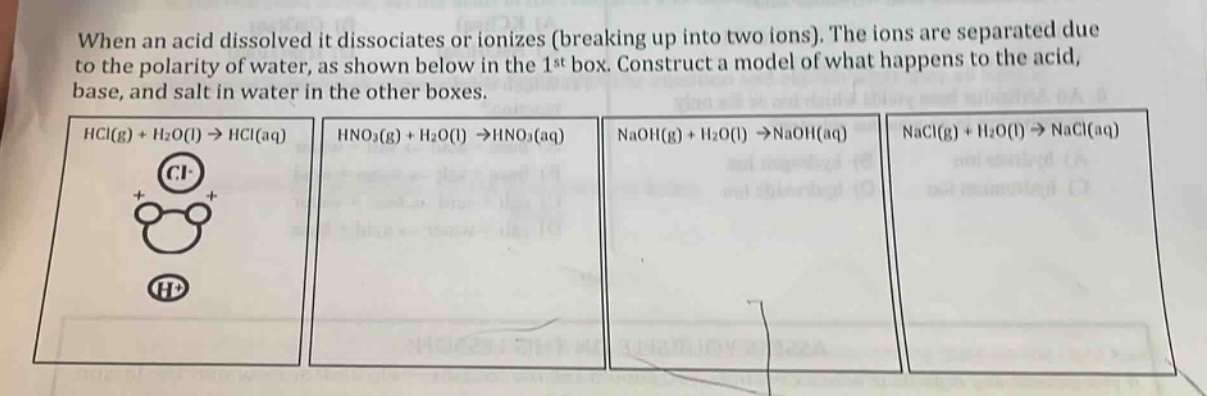
when an acid dissolved it dissociates or ionizes (breaking up into two ions). the ions are separated due to the polarity of water, as shown below in the 1st box. construct a model of what happens to the acid, base, and salt in water in the other boxes.\nhcl(g) + h₂o(l) → hcl(aq)\nhno₃(g) + h₂o(l) → hno₃(aq)\nnaoh(g) + h₂o(l) → naoh(aq)\nnacl(g) + h₂o(l) → nacl(aq)
Answer
Explanation:
Step1: Analyze dissociation of $HNO_3$
$HNO_3$ is a strong acid. In water, it dissociates into $H^+$ and $NO_3^-$ ions. So in the second box, we draw $H^+$ and $NO_3^-$ separated by water molecules.
Step2: Analyze dissociation of $NaOH$
$NaOH$ is a strong base. In water, it dissociates into $Na^+$ and $OH^-$ ions. So in the third box, we draw $Na^+$ and $OH^-$ separated by water molecules.
Step3: Analyze dissociation of $NaCl$
$NaCl$ is a salt. In water, it dissociates into $Na^+$ and $Cl^-$ ions. So in the fourth box, we draw $Na^+$ and $Cl^-$ separated by water molecules.
Answer:
For the second box ($HNO_3$): Draw $H^+$ and $NO_3^-$ separated by water - like structures. For the third box ($NaOH$): Draw $Na^+$ and $OH^-$ separated by water - like structures. For the fourth box ($NaCl$): Draw $Na^+$ and $Cl^-$ separated by water - like structures.