acids and bases- (chapter 22 section 2)\n1. what does ph mean?\n2. is blood considered to be an acid or…
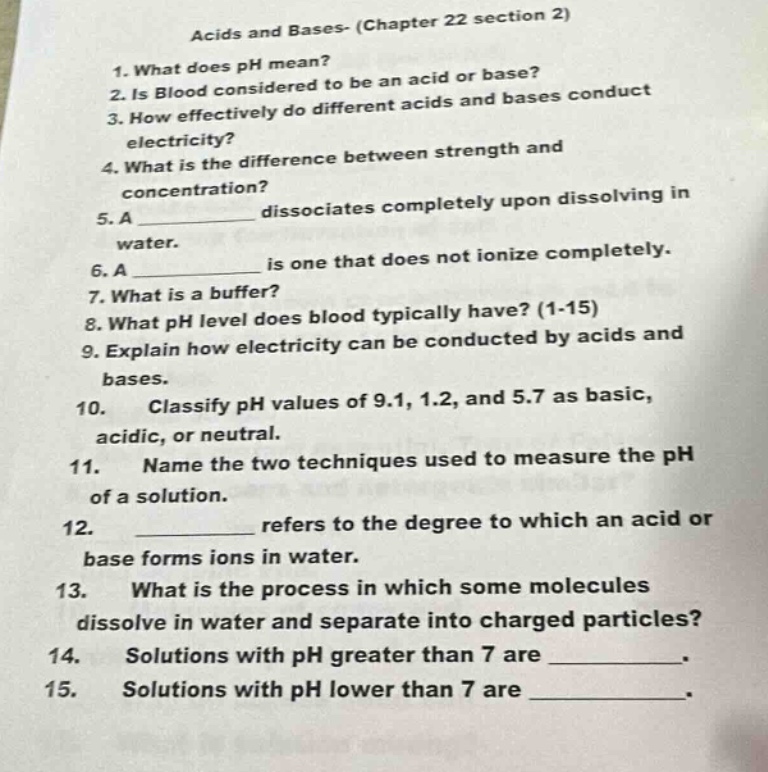
acids and bases- (chapter 22 section 2)\n1. what does ph mean?\n2. is blood considered to be an acid or base?\n3. how effectively do different acids and bases conduct electricity?\n4. what is the difference between strength and concentration?\n5. a ____________ dissociates completely upon dissolving in water.\n6. a ____________ is one that does not ionize completely.\n7. what is a buffer?\n8. what ph level does blood typically have? (1 - 15)\n9. explain how electricity can be conducted by acids and bases.\n10. classify ph values of 9.1, 1.2, and 5.7 as basic, acidic, or neutral.\n11. name the two techniques used to measure the ph of a solution.\n12. ____________ refers to the degree to which an acid or base forms ions in water.\n13. what is the process in which some molecules dissolve in water and separate into charged particles?\n14. solutions with ph greater than 7 are ____________.\n15. solutions with ph lower than 7 are ____________.
Answer
Brief Explanations:
- pH stands for the negative logarithm of the hydrogen - ion concentration in a solution, indicating its acidity or basicity.
- Blood is slightly basic with a pH around 7.35 - 7.45.
- Stronger acids and bases conduct electricity more effectively as they dissociate more to form ions for conduction.
- Strength refers to the degree of ionization, while concentration is the amount of solute per unit volume.
- A strong acid or strong base dissociates completely upon dissolving in water.
- A weak acid or weak base is one that does not ionize completely.
- A buffer is a solution that resists changes in pH when small amounts of acid or base are added.
- Blood typically has a pH of around 7.35 - 7.45.
- Acids and bases conduct electricity because they dissociate in water to form ions that can move and carry an electric current.
- A pH of 9.1 is basic, 1.2 is acidic, and 5.7 is acidic.
- The two common techniques to measure pH are using pH indicators and pH meters.
- Ionization refers to the degree to which an acid or base forms ions in water.
- The process in which some molecules dissolve in water and separate into charged particles is called dissociation.
- Solutions with pH greater than 7 are basic.
- Solutions with pH lower than 7 are acidic.
Answer:
- Negative logarithm of hydrogen - ion concentration.
- No, it is basic.
- Stronger ones conduct better due to more ionization.
- Strength: degree of ionization; Concentration: amount of solute per volume.
- Strong acid or strong base.
- Weak acid or weak base.
- Solution that resists pH changes.
- Around 7.35 - 7.45.
- Dissociation forms ions for conduction.
- 9.1: basic; 1.2: acidic; 5.7: acidic.
- pH indicators, pH meters.
- Ionization.
- Dissociation.
- Basic.
- Acidic.