acids and bases quiz - v.1\n1. which of the following is an appropriate statement for a strong acid?\n a. ph…
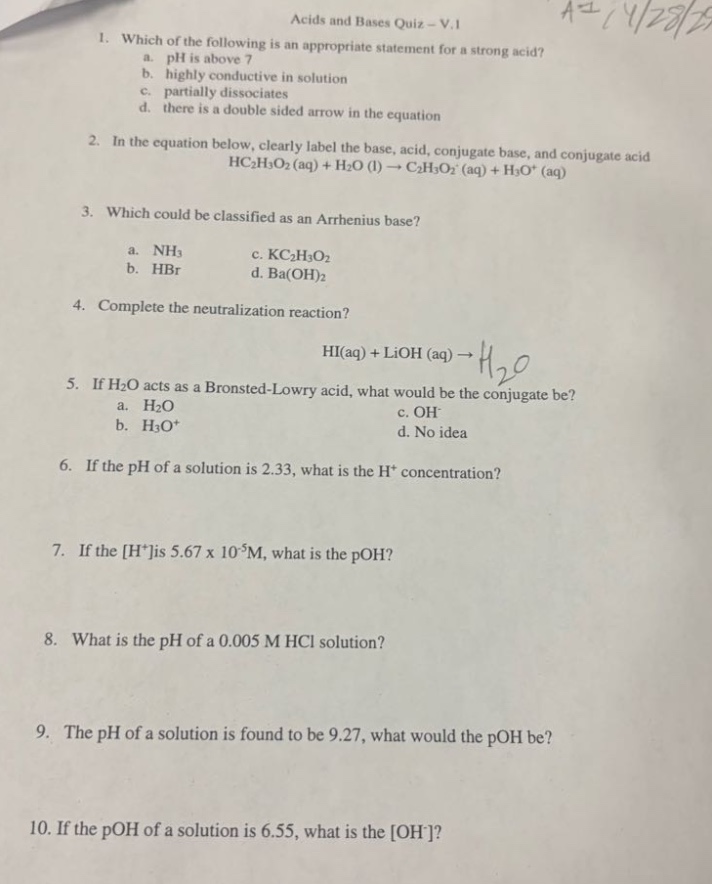
acids and bases quiz - v.1\n1. which of the following is an appropriate statement for a strong acid?\n a. ph is above 7\n b. highly conductive in solution\n c. partially dissociates\n d. there is a double - sided arrow in the equation\n2. in the equation below, clearly label the base, acid, conjugate base, and conjugate acid\n hc₂h₃o₂(aq)+h₂o(l)→c₂h₃o₂⁻(aq)+h₃o⁺(aq)\n3. which could be classified as an arrhenius base?\n a. nh₃\n c. kc₂h₃o₂\n b. hbr\n d. ba(oh)₂\n4. complete the neutralization reaction?\n hi(aq)+lioh(aq)→h₂o\n5. if h₂o acts as a bronsted - lowry acid, what would be the conjugate be?\n a. h₂o\n c. oh⁻\n b. h₃o⁺\n d. no idea\n6. if the ph of a solution is 2.33, what is the h⁺ concentration?\n7. if the h⁺ is 5.67 x 10⁻⁵m, what is the poh?\n8. what is the ph of a 0.005 m hcl solution?\n9. the ph of a solution is found to be 9.27, what would the poh be?\n10. if the poh of a solution is 6.55, what is the oh⁻?
Answer
Explanation:
Step1: Define strong acid properties
A strong acid completely dissociates in solution, producing a high concentration of ions, which makes the solution highly conductive. The pH of a strong - acid solution is below 7. Weak acids partially dissociate and have a double - sided arrow in their dissociation equations.
Step2: Answer question 1
The correct statement for a strong acid is that it is highly conductive in solution. So the answer to question 1 is b.
Step3: Identify acid - base pairs in question 2
In the equation $HC_2H_3O_2(aq)+H_2O(l)\rightarrow C_2H_3O_2^-(aq)+H_3O^+(aq)$, the acid is $HC_2H_3O_2$ (acetic acid), the base is $H_2O$ (water), the conjugate base is $C_2H_3O_2^-$ (acetate ion), and the conjugate acid is $H_3O^+$ (hydronium ion).
Step4: Recall Arrhenius base definition
An Arrhenius base is a substance that dissociates in water to produce $OH^-$ ions. $Ba(OH)_2$ dissociates as $Ba(OH)_2\rightarrow Ba^{2 + }+2OH^-$. $NH_3$ is a Brønsted - Lowry base, $HBr$ is an acid, and $KC_2H_3O_2$ is a salt. So the answer to question 3 is d.
Step5: Complete neutralization reaction in question 4
The neutralization reaction of $HI(aq)+LiOH(aq)$ produces water and a salt. The balanced reaction is $HI(aq)+LiOH(aq)\rightarrow H_2O(l)+LiI(aq)$.
Step6: Determine conjugate base for question 5
If $H_2O$ acts as a Brønsted - Lowry acid, it donates a proton ($H^+$). The conjugate base formed when $H_2O$ donates a proton is $OH^-$. So the answer is c.
Step7: Use pH formula for question 6
The formula for pH is $pH =-\log[H^+]$. Rearranging for $[H^+]$, we get $[H^+]=10^{-pH}$. Given $pH = 2.33$, then $[H^+]=10^{- 2.33}\approx4.68\times10^{-3}M$.
Step8: Use $[H^+]$ and $pOH$ relationship for question 7
First, find the pH using $pH =-\log[H^+]$. Given $[H^+]=5.67\times10^{-5}M$, then $pH=-\log(5.67\times10^{-5})\approx4.24$. Since $pH + pOH=14$, then $pOH = 14 - pH=14 - 4.24 = 9.76$.
Step9: Find pH of HCl solution in question 8
HCl is a strong acid, so $[H^+]=0.005M$. Using the pH formula $pH =-\log[H^+]$, we have $pH=-\log(0.005)=2.30$.
Step10: Use pH and pOH relationship for question 9
Since $pH + pOH = 14$, given $pH = 9.27$, then $pOH=14 - 9.27 = 4.73$.
Step11: Use pOH formula for question 10
The formula for pOH is $pOH=-\log[OH^-]$. Rearranging for $[OH^-]$, we get $[OH^-]=10^{-pOH}$. Given $pOH = 6.55$, then $[OH^-]=10^{-6.55}\approx2.82\times10^{-7}M$.
Answer:
- b. highly conductive in solution
- Acid: $HC_2H_3O_2$, Base: $H_2O$, Conjugate base: $C_2H_3O_2^-$, Conjugate acid: $H_3O^+$
- d. $Ba(OH)_2$
- $HI(aq)+LiOH(aq)\rightarrow H_2O(l)+LiI(aq)$
- c. $OH^-$
- $4.68\times10^{-3}M$
- 9.76
- 2.30
- 4.73
- $2.82\times10^{-7}M$