activity a: temperature\nget the gizmo ready:\n• click reset ( 2 ).\n• check that the reactant concentration…
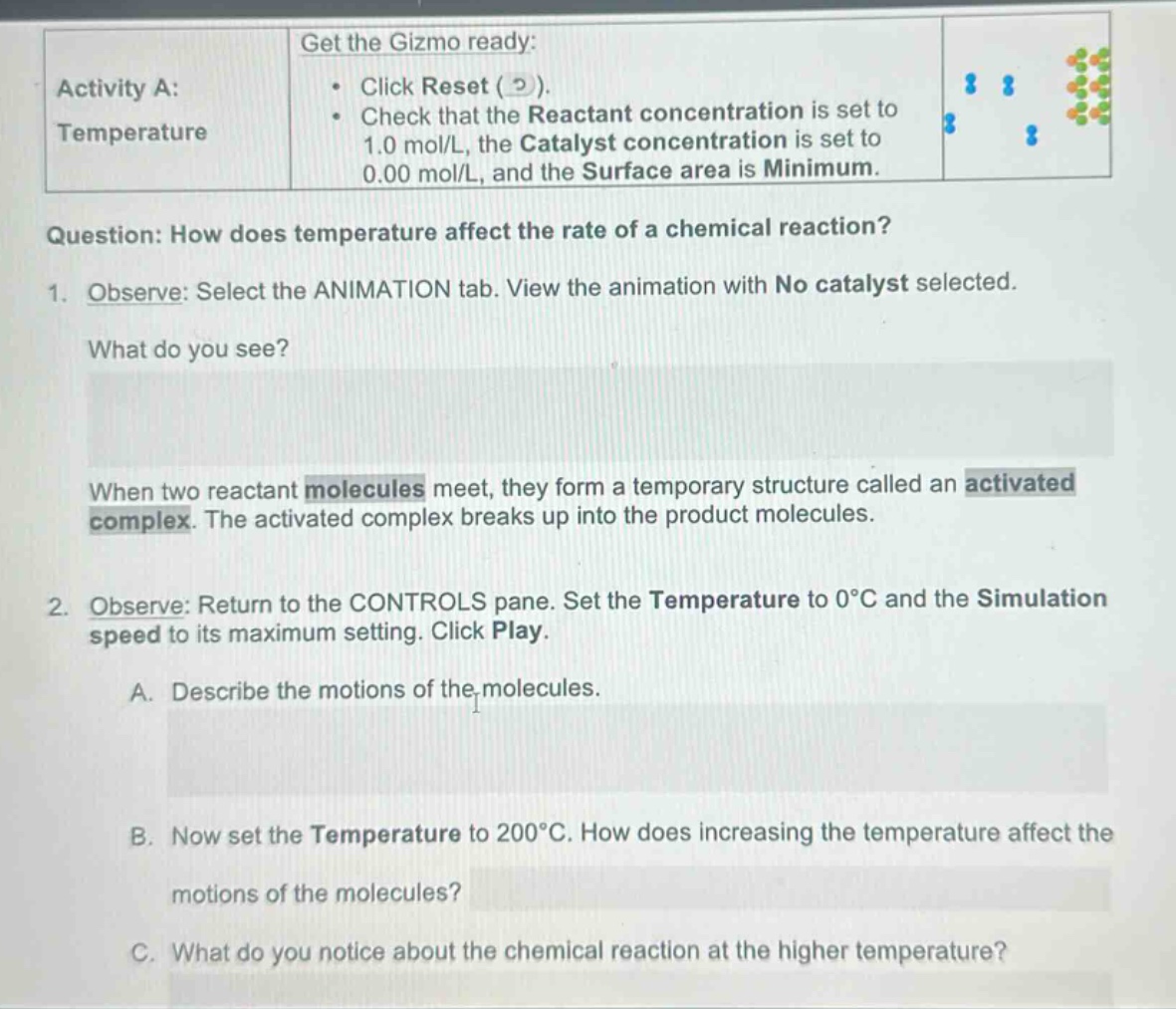
activity a: temperature\nget the gizmo ready:\n• click reset ( 2 ).\n• check that the reactant concentration is set to 1.0 mol/l, the catalyst concentration is set to 0.00 mol/l, and the surface area is minimum.\nquestion: how does temperature affect the rate of a chemical reaction?\n1. observe: select the animation tab. view the animation with no catalyst selected.\nwhat do you see?\nwhen two reactant molecules meet, they form a temporary structure called an activated complex. the activated complex breaks up into the product molecules.\n2. observe: return to the controls pane. set the temperature to 0°c and the simulation speed to its maximum setting. click play.\na. describe the motions of the molecules.\nb. now set the temperature to 200°c. how does increasing the temperature affect the motions of the molecules?\nc. what do you notice about the chemical reaction at the higher temperature?
Answer
Explanation:
Step1: Observe at 0°C
At 0°C, the molecules move relatively slowly. They have less kinetic - energy, resulting in fewer and less energetic collisions.
Step2: Observe at 200°C
When the temperature is increased to 200°C, the molecules move much more rapidly. The increased kinetic energy leads to more frequent and more energetic collisions.
Step3: Analyze chemical reaction at higher temperature
At the higher temperature (200°C), the chemical reaction occurs more quickly. The increased frequency and energy of collisions mean more reactant molecules have enough energy to form the activated complex and proceed to form products.
Answer:
A. At 0°C, the molecules move slowly with less frequent and less energetic collisions. B. Increasing the temperature to 200°C makes the molecules move much more rapidly, with more frequent and more energetic collisions. C. The chemical reaction occurs more quickly at the higher temperature due to more frequent and energetic collisions allowing more reactants to form products.