activity time!\ntry and learn\n• calculate the ionic strength of 0.10 m cacl2\n• determine the activity…
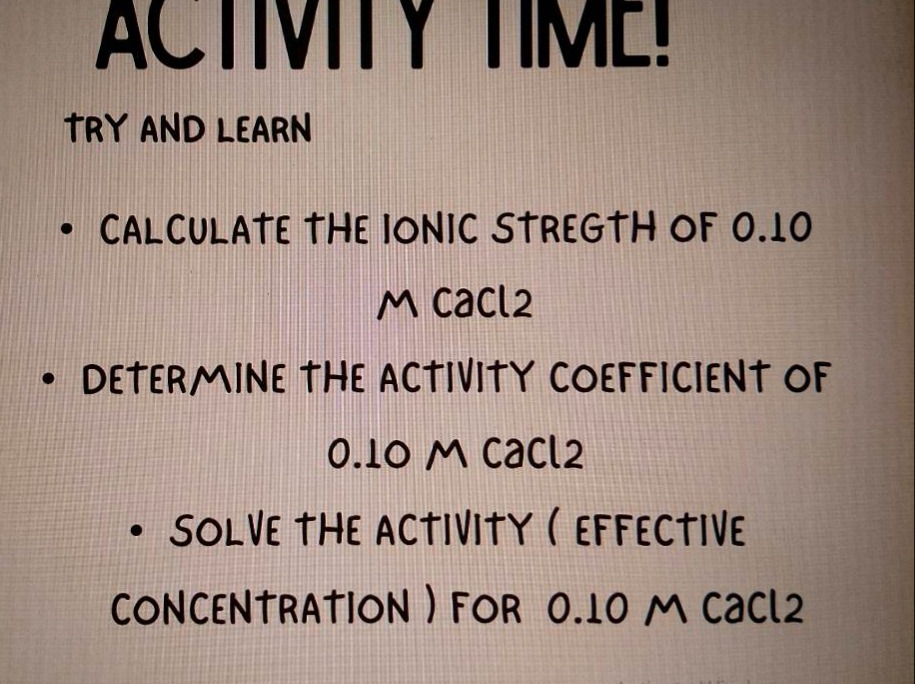
activity time!\ntry and learn\n• calculate the ionic strength of 0.10 m cacl2\n• determine the activity coefficient of 0.10 m cacl2\n• solve the activity ( effective concentration ) for 0.10 m cacl2
Answer
Explanation:
Step1: Write dissociation equation
$CaCl_2\rightarrow Ca^{2 +}+2Cl^{-}$
Step2: Calculate ionic strength ($I$)
The formula for ionic strength is $I=\frac{1}{2}\sum_{i}c_{i}z_{i}^{2}$, where $c_{i}$ is the molar - concentration of the $i$ - th ion and $z_{i}$ is its charge. For $CaCl_2$, $c_{Ca^{2+}} = 0.10\ M$, $z_{Ca^{2+}}=2$, $c_{Cl^{-}}=0.20\ M$, $z_{Cl^{-}} = 1$. $I=\frac{1}{2}(0.10\times2^{2}+0.20\times1^{2})=\frac{1}{2}(0.40 + 0.20)=0.30\ M$
Step3: Determine activity coefficient ($\gamma$) using Debye - Hückel limiting law
For a 1 - 2 electrolyte at $I = 0.30\ M$, we can use the extended Debye - Hückel equation $\log\gamma_{\pm}=-0.51z_{+}z_{-}\sqrt{\frac{I}{1 + Ba\sqrt{I}}}$. For a dilute solution approximation (Debye - Hückel limiting law), when $I$ is relatively small, $\log\gamma_{\pm}=-0.51z_{+}z_{-}\sqrt{I}$. Here $z_{+} = 2$, $z_{-}=1$, so $\log\gamma_{\pm}=-0.51\times2\times1\times\sqrt{0.30}\approx - 0.56$. Then $\gamma_{\pm}=10^{- 0.56}\approx0.27$
Step4: Calculate activity ($a$)
The activity is given by the formula $a = \gamma\times c$. For $CaCl_2$, $a=\gamma_{\pm}\times c = 0.27\times0.10 = 0.027\ M$
Answer:
Ionic strength: $0.30\ M$; Activity coefficient: $0.27$; Activity: $0.027\ M$