al is oxidized in a spontaneous cell made from tin and aluminum. the overall cell has an ( e_{\text{cell}} )…
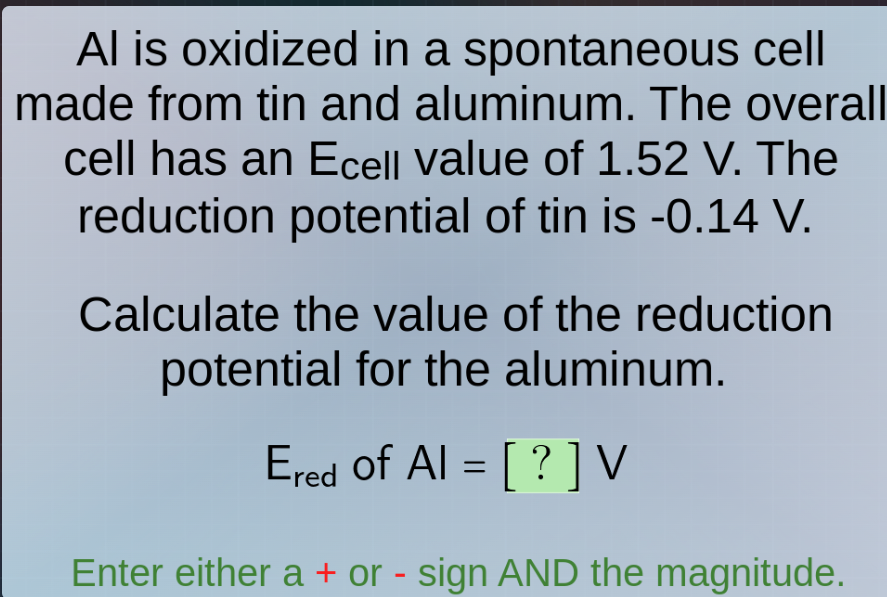
al is oxidized in a spontaneous cell made from tin and aluminum. the overall cell has an ( e_{\text{cell}} ) value of 1.52 v. the reduction potential of tin is -0.14 v. calculate the value of the reduction potential for the aluminum. ( e_{\text{red}} ) of al = ? v enter either a + or - sign and the magnitude.
Answer
Explanation:
Step1: Recall the cell potential formula
For a spontaneous electrochemical cell, ( E_{\text{cell}} = E_{\text{cathode (reduction)}} - E_{\text{anode (reduction)}} ). Since Al is oxidized, it is the anode (oxidation occurs at anode), and Sn is reduced (cathode, as reduction occurs at cathode). So ( E_{\text{cell}} = E_{\text{red (Sn)}} - E_{\text{red (Al)}} ).
Step2: Rearrange the formula to solve for ( E_{\text{red (Al)}} )
We have ( E_{\text{red (Al)}} = E_{\text{red (Sn)}} - E_{\text{cell}} ).
Step3: Substitute the given values
Given ( E_{\text{cell}} = 1.52 , \text{V} ) and ( E_{\text{red (Sn)}} = -0.14 , \text{V} ). Substituting these values: ( E_{\text{red (Al)}} = -0.14 - 1.52 ).
Step4: Calculate the result
( -0.14 - 1.52 = -1.66 , \text{V} ).
Answer:
-1.66