ammonia (nh₃) is a principal nitrogen fertilizer. it is prepared by the reaction between hydrogen (h₂) and…
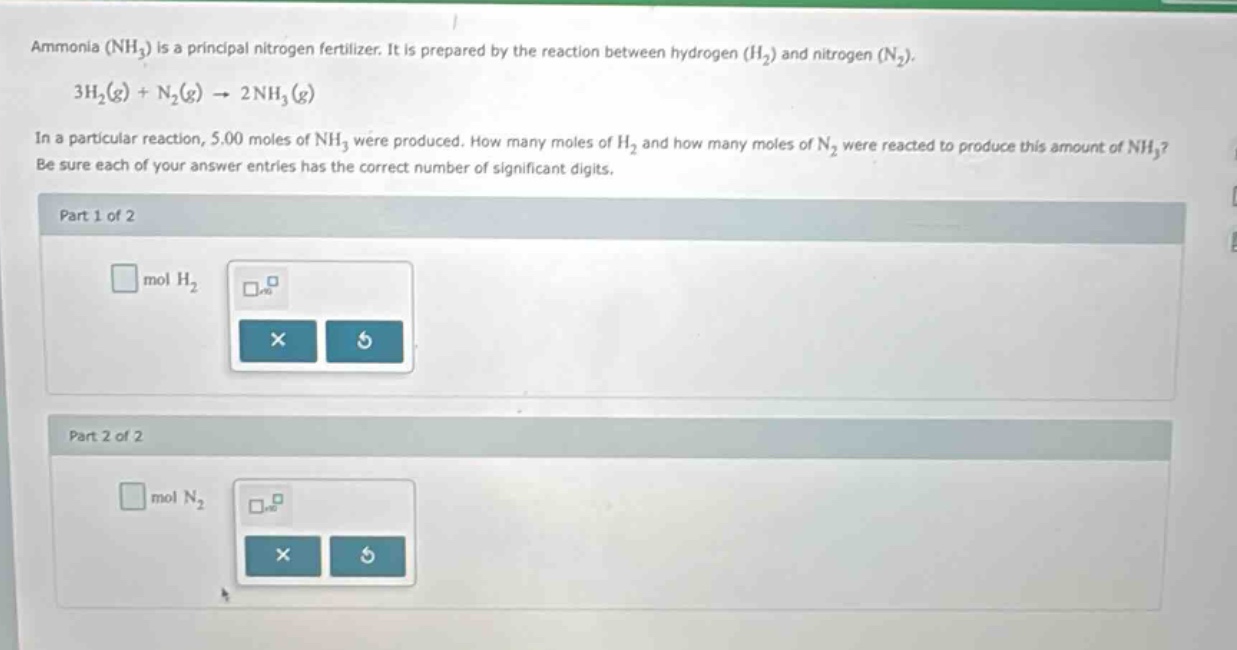
ammonia (nh₃) is a principal nitrogen fertilizer. it is prepared by the reaction between hydrogen (h₂) and nitrogen (n₂). 3h₂(g) + n₂(g) → 2nh₃(g) in a particular reaction, 5.00 moles of nh₃ were produced. how many moles of h₂ and how many moles of n₂ were reacted to produce this amount of nh₃? be sure each of your answer entries has the correct number of significant digits. part 1 of 2 mol h₂ part 2 of 2 mol n₂
Answer
Explanation:
Step1: Determine mole - ratio from balanced equation
The balanced equation is $3H_2(g)+N_2(g)\rightarrow2NH_3(g)$. The mole - ratio of $H_2$ to $NH_3$ is $\frac{3}{2}$, and the mole - ratio of $N_2$ to $NH_3$ is $\frac{1}{2}$.
Step2: Calculate moles of $H_2$
We know $n_{NH_3}=5.00$ mol. Using the mole - ratio $\frac{n_{H_2}}{n_{NH_3}}=\frac{3}{2}$, we can solve for $n_{H_2}$. So $n_{H_2}=\frac{3}{2}\times n_{NH_3}=\frac{3}{2}\times5.00$ mol $ = 7.50$ mol.
Step3: Calculate moles of $N_2$
Using the mole - ratio $\frac{n_{N_2}}{n_{NH_3}}=\frac{1}{2}$, and $n_{NH_3}=5.00$ mol. Then $n_{N_2}=\frac{1}{2}\times n_{NH_3}=\frac{1}{2}\times5.00$ mol $ = 2.50$ mol.
Answer:
Part 1 of 2: 7.50 mol $H_2$ Part 2 of 2: 2.50 mol $N_2$