another process in the chemical equation you balanced in question 2 was not shown. just as sodium stearate…
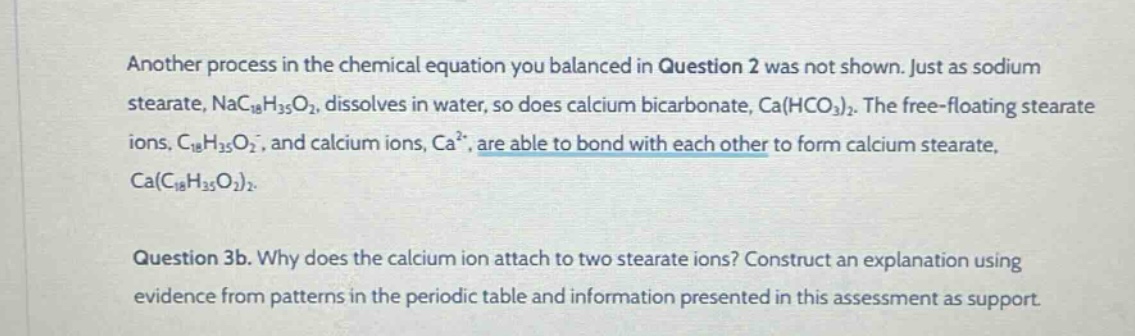
another process in the chemical equation you balanced in question 2 was not shown. just as sodium stearate, nac₁₈h₃₅o₂, dissolves in water, so does calcium bicarbonate, ca(hco₃)₂. the free - floating stearate ions, c₁₈h₃₅o₂⁻, and calcium ions, ca²⁺, are able to bond with each other to form calcium stearate, ca(c₁₈h₃₅o₂)₂.\n\nquestion 3b. why does the calcium ion attach to two stearate ions? construct an explanation using evidence from patterns in the periodic table and information presented in this assessment as support.
Answer
Brief Explanation:
Calcium is in Group 2 of the periodic table, so it has a +2 charge ($Ca^{2 +}$). The stearate ion, $C_{18}H_{35}O_{2}^{-}$, has a -1 charge. To achieve electrical - neutrality in the compound, two stearate ions with a total charge of - 2 are needed to balance the +2 charge of the calcium ion.
Answer:
Calcium has a +2 charge and stearate has a -1 charge. Two stearate ions are needed to balance the charge of one calcium ion for electrical - neutrality.