answer the discussion questions below.\nwhy are some cousins smiling while others are frowning? (hint: think…
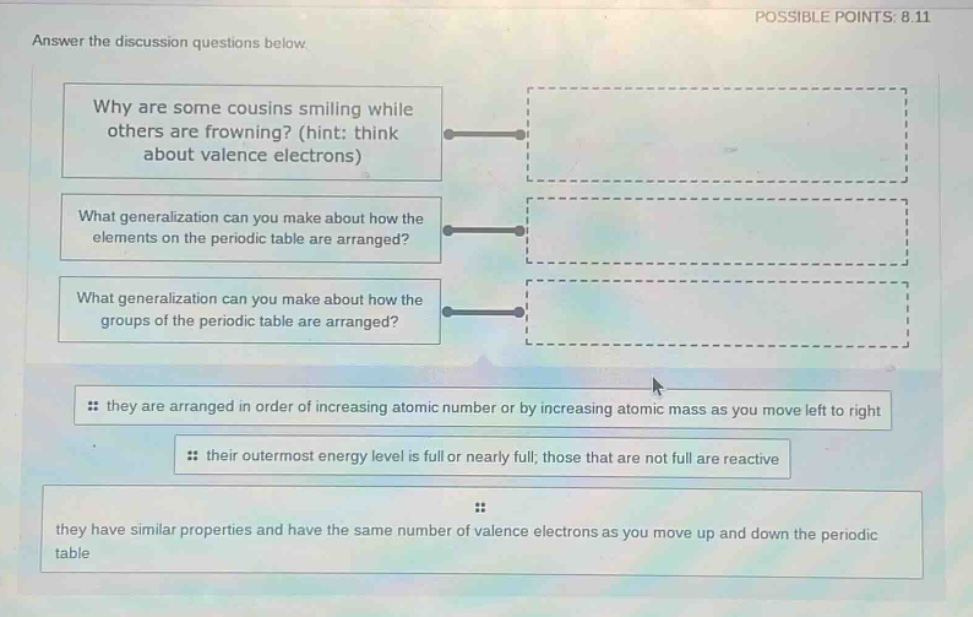
answer the discussion questions below.\nwhy are some cousins smiling while others are frowning? (hint: think about valence electrons)\nwhat generalization can you make about how the elements on the periodic table are arranged?\nwhat generalization can you make about how the groups of the periodic table are arranged?\n: they are arranged in order of increasing atomic number or by increasing atomic mass as you move left to right\n: their outermost energy level is full or nearly full; those that are not full are reactive\n: they have similar properties and have the same number of valence electrons as you move up and down the periodic table
Answer
Explanation:
Step1: Analyze the first question
The hint about valence - electrons suggests that atoms with a full or nearly full outermost energy level are more stable and might be "smiling" metaphorically, while those with incomplete outer - shells are reactive and might be "frowning". Atoms with a full or nearly full outermost energy level are less likely to react, which can be related to a more "content" state, and atoms with incomplete outer - shells are more likely to react to achieve a stable electron configuration.
Step2: Analyze the second question
Elements on the periodic table are arranged in order of increasing atomic number (or historically, by increasing atomic mass in some early versions). As you move from left to right across a period, the atomic number increases. This arrangement leads to trends in properties such as atomic radius, ionization energy, and electronegativity.
Step3: Analyze the third question
Elements in the same group of the periodic table have similar properties because they have the same number of valence electrons. Moving up and down a group, the number of electron shells changes, but the number of valence electrons remains the same, resulting in similar chemical behavior.
Answer:
- Atoms with a full or nearly full outermost energy level are more stable and can be considered as "smiling", while those with incomplete outer - shells are reactive and can be considered as "frowning" due to their tendency to react to achieve a stable electron configuration.
- Elements on the periodic table are arranged in order of increasing atomic number (or historically, by increasing atomic mass as you move left to right).
- Elements in the same group of the periodic table have similar properties and have the same number of valence electrons as you move up and down the periodic table.