5. apply determine the names of kclo, kio₄, nabro₃, and naclo₂.
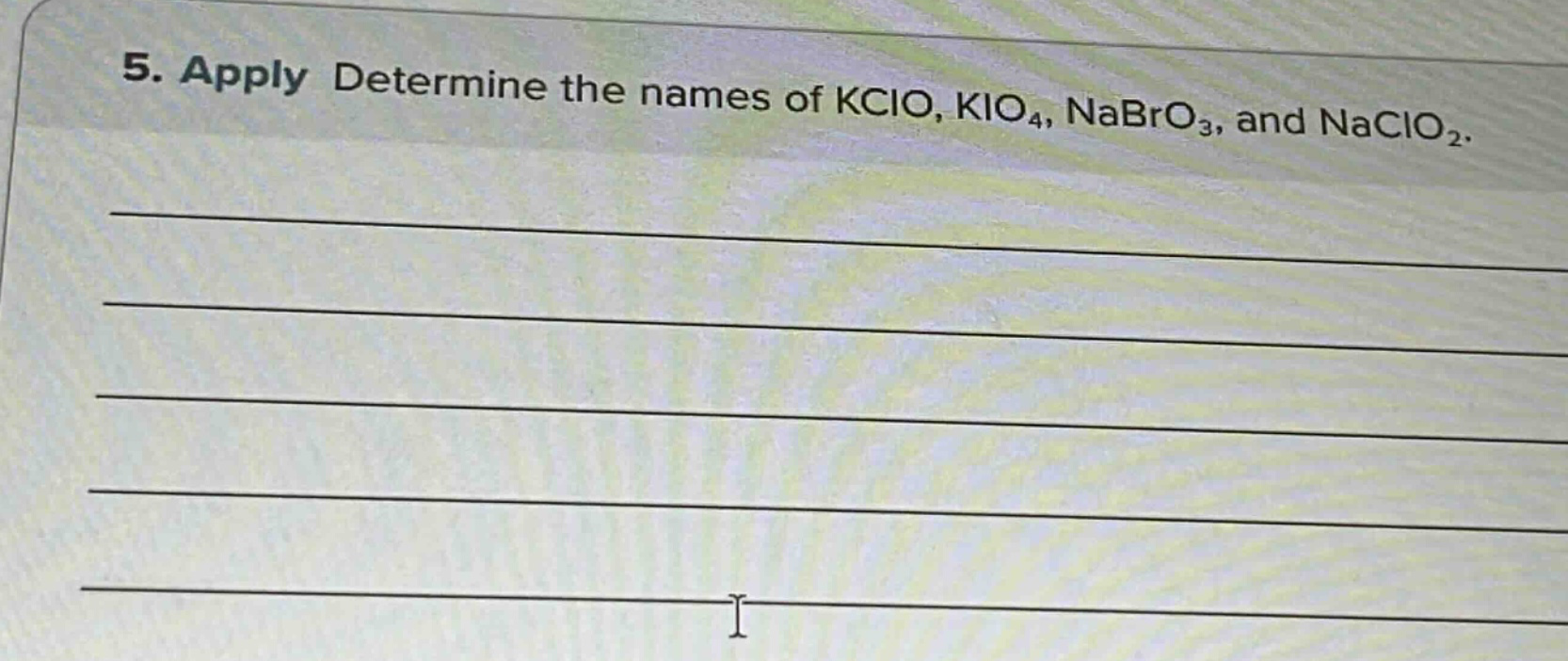
5. apply determine the names of kclo, kio₄, nabro₃, and naclo₂.
Answer
Brief Explanations:
For ionic compounds, name the cation first followed by the anion. For oxy - anions, use specific naming rules.
- In KClO, the cation is potassium (K⁺) and the anion is hypochlorite (ClO⁻), so it is potassium hypochlorite.
- In KIO₄, the cation is potassium (K⁺) and the anion is periodate (IO₄⁻), so it is potassium periodate.
- In NaBrO₃, the cation is sodium (Na⁺) and the anion is bromate (BrO₃⁻), so it is sodium bromate.
- In NaClO₂, the cation is sodium (Na⁺) and the anion is chlorite (ClO₂⁻), so it is sodium chlorite.
Answer:
- Potassium hypochlorite
- Potassium periodate
- Sodium bromate
- Sodium chlorite