an aqueous solution contains 0.22 m ammonium bromide. one liter of this solution could be converted into a…
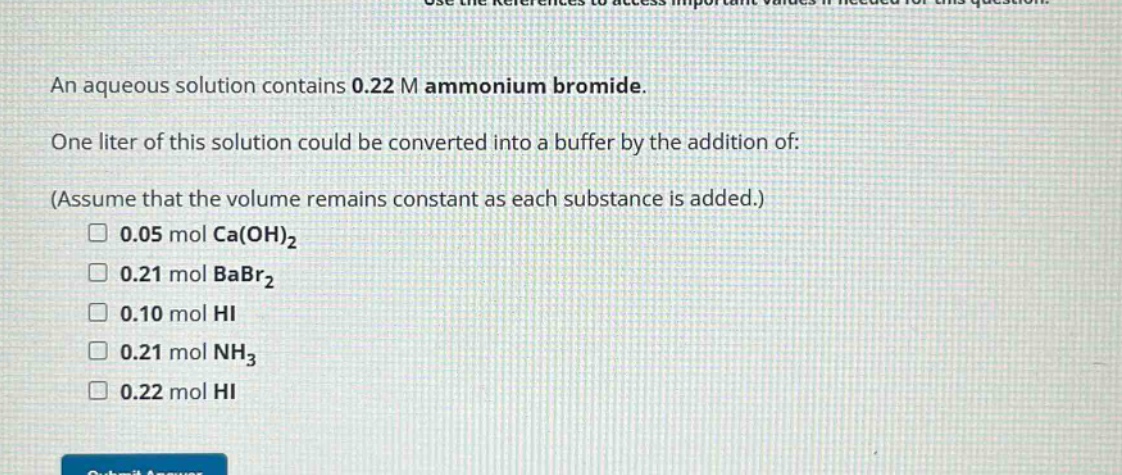
an aqueous solution contains 0.22 m ammonium bromide. one liter of this solution could be converted into a buffer by the addition of: (assume that the volume remains constant as each substance is added.) 0.05 mol ca(oh)₂ 0.21 mol babr₂ 0.10 mol hi 0.21 mol nh₃ 0.22 mol hi
Answer
Explanation:
Step1: Recall buffer solution composition
A buffer solution consists of a weak acid and its conjugate base or a weak base and its conjugate acid. Here, ammonium bromide ($\ce{NH4Br}$) dissociates to give $\ce{NH4+}$. $\ce{NH4+}$ is the conjugate acid of the weak base $\ce{NH3}$.
Step2: Analyze each option
- Option 1: $0.05\ mol\ \ce{Ca(OH)2}$ $\ce{Ca(OH)2}$ is a strong base. The reaction with $\ce{NH4Br}$: $\ce{2NH4Br + Ca(OH)2=CaBr2 + 2NH3 + 2H2O}$. The moles of $\ce{NH4Br}=0.22\ mol$ (since $n = C\times V$, $C = 0.22\ M$, $V = 1\ L$). Moles of $\ce{OH-}$ from $\ce{Ca(OH)2}=2\times0.05\ mol = 0.1\ mol$. After reaction, moles of $\ce{NH4+}=(0.22 - 0.1)\ mol=0.12\ mol$ and moles of $\ce{NH3}=0.1\ mol$. But the amount of base added is not in a suitable ratio to form a good - buffer (also, strong base addition is not ideal for a buffer with $\ce{NH4+}$ as the main species initially).
- Option 2: $0.21\ mol\ \ce{BaBr2}$ $\ce{BaBr2}$ is a salt. It does not provide a weak base or a strong acid (to convert a suitable amount of $\ce{NH4+}$ to $\ce{NH3}$) to form a buffer with $\ce{NH4Br}$.
- Option 3: $0.10\ mol\ \ce{HI}$ $\ce{HI}$ is a strong acid. It will react with $\ce{NH4Br}$ (no reaction as $\ce{NH4+}$ is already an acid). It does not form a conjugate - base/weak - acid or conjugate - acid/weak - base pair.
- Option 4: $0.21\ mol\ \ce{NH3}$ We have $\ce{NH4Br}$ which gives $\ce{NH4+}$ ($n=\ 0.22\ mol$ as $n = C\times V$, $C = 0.22\ M$, $V = 1\ L$) and we add $\ce{NH3}$ ($n = 0.21\ mol$). We get a mixture of $\ce{NH4+}$ (conjugate acid) and $\ce{NH3}$ (weak base). According to the Henderson - Hasselbalch equation $pH=pK_a+\log\frac{[base]}{[acid]}$, a buffer is formed.
- Option 5: $0.22\ mol\ \ce{HI}$ $\ce{HI}$ is a strong acid. $\ce{NH4Br + HI}$: $\ce{NH4+}$ is an acid and $\ce{HI}$ is also an acid. No reaction to form a conjugate - base/weak - acid pair.
Answer:
$0.21\ mol\ \ce{NH3}$