assign an oxidation number to each element in the reaction.\ncaf₂(s) + h₂so₄(aq) → caso₄(aq) + 2hf(g)\nin…
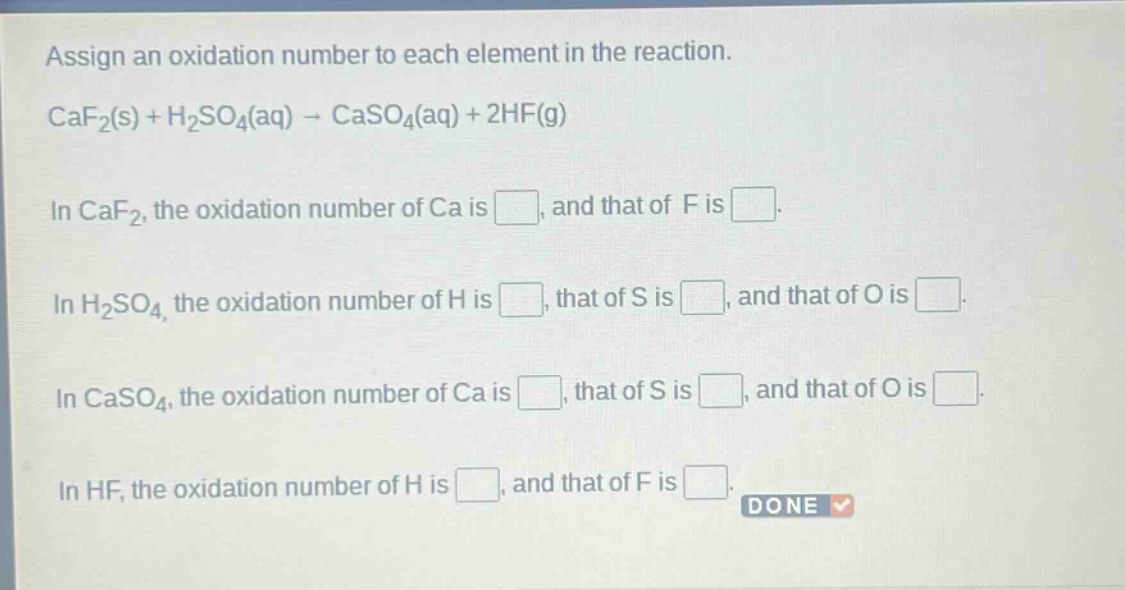
assign an oxidation number to each element in the reaction.\ncaf₂(s) + h₂so₄(aq) → caso₄(aq) + 2hf(g)\nin caf₂, the oxidation number of ca is , and that of f is .\nin h₂so₄, the oxidation number of h is , that of s is , and that of o is .\nin caso₄, the oxidation number of ca is , that of s is , and that of o is .\nin hf, the oxidation number of h is , and that of f is .
Answer
Explanation:
Step1: Oxidation number of Ca in CaF₂
Calcium is an alkaline - earth metal and usually has an oxidation number of +2 in its compounds. So, in CaF₂, the oxidation number of Ca is +2.
Step2: Oxidation number of F in CaF₂
The sum of oxidation numbers in a neutral compound is 0. Let the oxidation number of F be (x). Since Ca has an oxidation number of +2 and there are 2 F atoms, (+ 2+2x = 0), solving for (x) gives (x=-1).
Step3: Oxidation number of H in H₂SO₄
Hydrogen usually has an oxidation number of +1 in its compounds. So, in H₂SO₄, the oxidation number of H is +1.
Step4: Oxidation number of O in H₂SO₄
Oxygen usually has an oxidation number of -2 in its compounds. So, in H₂SO₄, the oxidation number of O is -2.
Step5: Oxidation number of S in H₂SO₄
Let the oxidation number of S be (y). In H₂SO₄, with 2 H atoms (+1 each) and 4 O atoms (-2 each), the sum of oxidation numbers is 0. So, (2\times(+1)+y + 4\times(-2)=0), which simplifies to (2 + y-8 = 0), and (y = +6).
Step6: Oxidation number of Ca in CaSO₄
Calcium has an oxidation number of +2 in CaSO₄.
Step7: Oxidation number of O in CaSO₄
Oxygen has an oxidation number of -2 in CaSO₄.
Step8: Oxidation number of S in CaSO₄
Let the oxidation number of S be (z). In CaSO₄, with Ca (+2) and 4 O atoms (-2 each), (+2+z + 4\times(-2)=0), which simplifies to (2+z - 8 = 0), and (z = +6).
Step9: Oxidation number of H in HF
Hydrogen has an oxidation number of +1 in HF.
Step10: Oxidation number of F in HF
The sum of oxidation numbers in HF is 0. Since H has an oxidation number of +1, the oxidation number of F is -1.
Answer:
In CaF₂, the oxidation number of Ca is +2, and that of F is -1. In H₂SO₄, the oxidation number of H is +1, that of S is +6, and that of O is -2. In CaSO₄, the oxidation number of Ca is +2, that of S is +6, and that of O is -2. In HF, the oxidation number of H is +1, and that of F is -1.