assign an oxidation number to each element in the reaction.\nco(g) + 2h₂(g) → ch₃oh(g)\nin co, the oxidation…
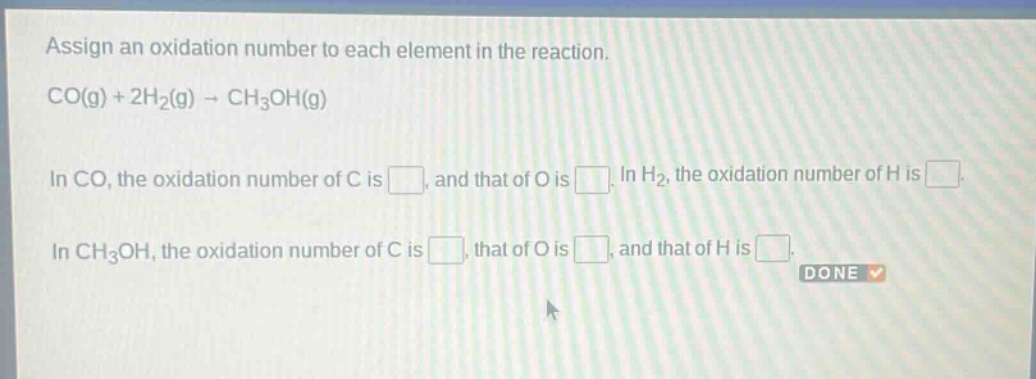
assign an oxidation number to each element in the reaction.\nco(g) + 2h₂(g) → ch₃oh(g)\nin co, the oxidation number of c is , and that of o is . in h₂, the oxidation number of h is .\nin ch₃oh, the oxidation number of c is , that of o is , and that of h is .
Answer
Explanation:
Step1: Oxidation number rules for CO
Oxygen usually has an oxidation number of -2 in compounds. Let the oxidation number of C in CO be (x). Using the rule that the sum of oxidation numbers in a neutral compound is 0, we have (x+( - 2)=0).
Step2: Solve for C in CO
Solving (x - 2=0) gives (x = + 2). So in CO, C is +2 and O is -2.
Step3: Oxidation number of H in (H_2)
In an elemental form, the oxidation number of an element is 0. So in (H_2), the oxidation number of H is 0.
Step4: Oxidation number rules for (CH_3OH)
Oxygen has an oxidation number of -2 and hydrogen has an oxidation number of +1 in most compounds. Let the oxidation number of C in (CH_3OH) be (y). The sum of oxidation numbers in (CH_3OH) is (y+(+1)\times4+( - 2)=0).
Step5: Solve for C in (CH_3OH)
Simplify the equation (y + 4-2=0), which is (y+2 = 0), so (y=-2).
Answer:
In CO, the oxidation number of C is +2, and that of O is -2. In (H_2), the oxidation number of H is 0. In (CH_3OH), the oxidation number of C is -2, that of O is -2, and that of H is +1.