when an atom that has no charge loses two electrons, it becomes a positive ion. negative ion. positive…
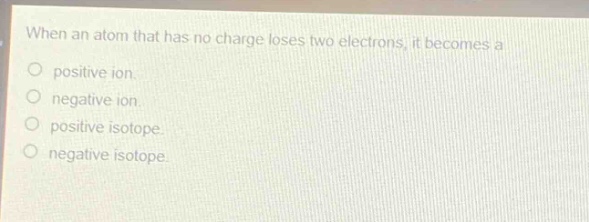
when an atom that has no charge loses two electrons, it becomes a positive ion. negative ion. positive isotope. negative isotope.
Answer
Brief Explanations:
An atom is neutral when the number of protons (positively - charged) equals the number of electrons (negatively - charged). When it loses two electrons, it has two more protons than electrons, giving it a net positive charge. Ions are atoms with a charge, and isotopes are atoms of the same element with different numbers of neutrons.
Answer:
positive ion.