an atom of lithium (li) forms an ionic bond with an atom of chlorine (cl) to form lithium chloride. how are…
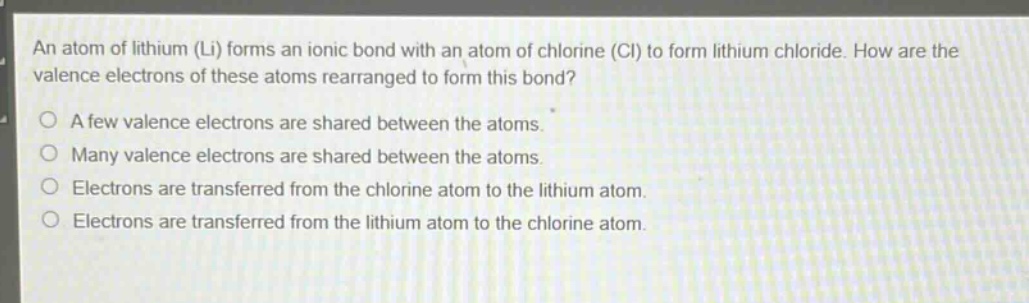
an atom of lithium (li) forms an ionic bond with an atom of chlorine (cl) to form lithium chloride. how are the valence electrons of these atoms rearranged to form this bond?\no a few valence electrons are shared between the atoms.\no many valence electrons are shared between the atoms.\no electrons are transferred from the chlorine atom to the lithium atom.\no electrons are transferred from the lithium atom to the chlorine atom.
Answer
Brief Explanations:
Ionic bonds form through electron - transfer. Lithium (Li) is a metal with 1 valence electron and chlorine (Cl) is a non - metal with 7 valence electrons. Lithium will lose its 1 valence electron to achieve a stable electron configuration, and chlorine will gain that electron to complete its outer shell.
Answer:
D. Electrons are transferred from the lithium atom to the chlorine atom.