what is the balanced chemical reaction for the cell with a potential of 1.52 v? \nstandard reduction…
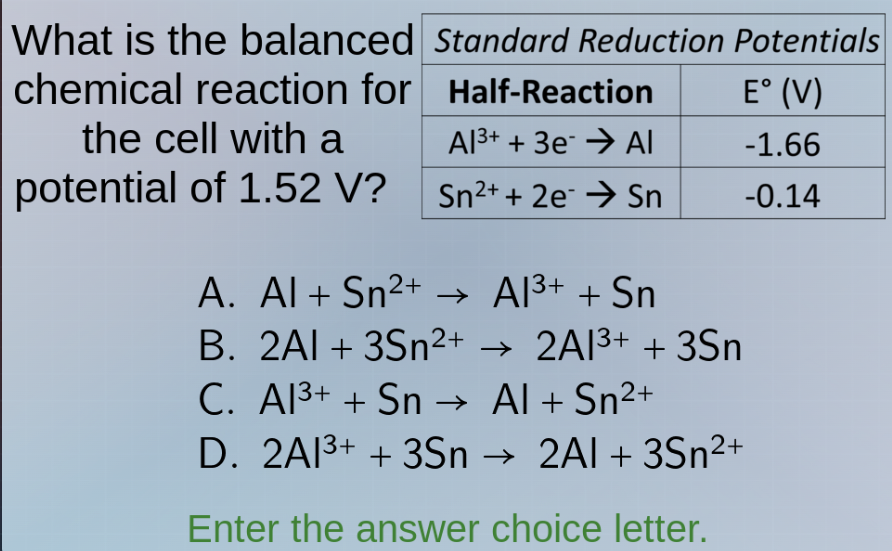
what is the balanced chemical reaction for the cell with a potential of 1.52 v? \nstandard reduction potentials\nhalf-reaction | e° (v)\nal³⁺ + 3e⁻ → al | -1.66\nsn²⁺ + 2e⁻ → sn | -0.14\na. al + sn²⁺ → al³⁺ + sn\nb. 2al + 3sn²⁺ → 2al³⁺ + 3sn\nc. al³⁺ + sn → al + sn²⁺\nd. 2al³⁺ + 3sn → 2al + 3sn²⁺\nenter the answer choice letter.
Answer
Brief Explanations:
To determine the balanced reaction, we first identify the anode (oxidation) and cathode (reduction) from standard reduction potentials. A more negative ( E^\circ ) means the species is a stronger reducing agent (undergoes oxidation). ( \text{Al}^{3+} + 3e^- \rightarrow \text{Al} ) has ( E^\circ = -1.66 , \text{V} ) (more negative), so Al is oxidized (anode: ( \text{Al} \rightarrow \text{Al}^{3+} + 3e^- )). ( \text{Sn}^{2+} + 2e^- \rightarrow \text{Sn} ) has ( E^\circ = -0.14 , \text{V} ), so ( \text{Sn}^{2+} ) is reduced (cathode: ( \text{Sn}^{2+} + 2e^- \rightarrow \text{Sn} )). To balance electrons, multiply oxidation by 2 (( 2\text{Al} \rightarrow 2\text{Al}^{3+} + 6e^- )) and reduction by 3 (( 3\text{Sn}^{2+} + 6e^- \rightarrow 3\text{Sn} )). Add them: ( 2\text{Al} + 3\text{Sn}^{2+} \rightarrow 2\text{Al}^{3+} + 3\text{Sn} ), which matches option B. The cell potential is ( E^\circ_{\text{cell}} = E^\circ_{\text{cathode}} - E^\circ_{\text{anode}} = -0.14 - (-1.66) = 1.52 , \text{V} ), confirming the reaction.