the balanced equation shows how sodium chloride reacts with silver nitrate to form sodium nitrate and silver…
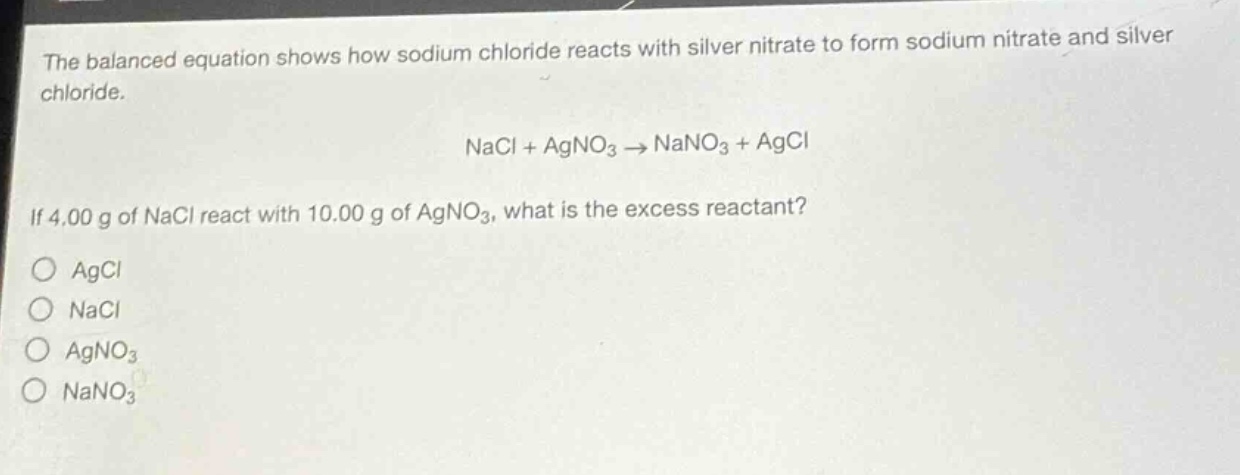
the balanced equation shows how sodium chloride reacts with silver nitrate to form sodium nitrate and silver chloride.\n\nnacl + agno₃ → nano₃ + agcl\n\nif 4.00 g of nacl react with 10.00 g of agno₃, what is the excess reactant?\n\n○ agcl\n○ nacl\n○ agno₃\n○ nano₃
Answer
Explanation:
Step1: Calculate molar masses
The molar mass of $NaCl$ is $M_{NaCl}=22.99 + 35.45=58.44$ g/mol. The molar mass of $AgNO_3$ is $M_{AgNO_3}=107.87+14.01 + 3\times16.00 = 169.88$ g/mol.
Step2: Calculate moles of reactants
The number of moles of $NaCl$, $n_{NaCl}=\frac{m_{NaCl}}{M_{NaCl}}=\frac{4.00\ g}{58.44\ g/mol}\approx0.0685$ mol. The number of moles of $AgNO_3$, $n_{AgNO_3}=\frac{m_{AgNO_3}}{M_{AgNO_3}}=\frac{10.00\ g}{169.88\ g/mol}\approx0.0589$ mol.
Step3: Determine the stoichiometric ratio
From the balanced - equation $NaCl + AgNO_3\rightarrow NaNO_3+AgCl$, the mole ratio of $NaCl$ to $AgNO_3$ is $1:1$.
Step4: Identify the limiting and excess reactants
Based on the mole - to - mole ratio, for every 1 mole of $NaCl$ that reacts, 1 mole of $AgNO_3$ reacts. Since $n_{NaCl}=0.0685$ mol and $n_{AgNO_3}=0.0589$ mol, $AgNO_3$ will be completely consumed first. So, $NaCl$ is the excess reactant.
Answer:
B. $NaCl$