balancing and classifying equations quiz\npart 1: write the formula for the following compounds:\n1…
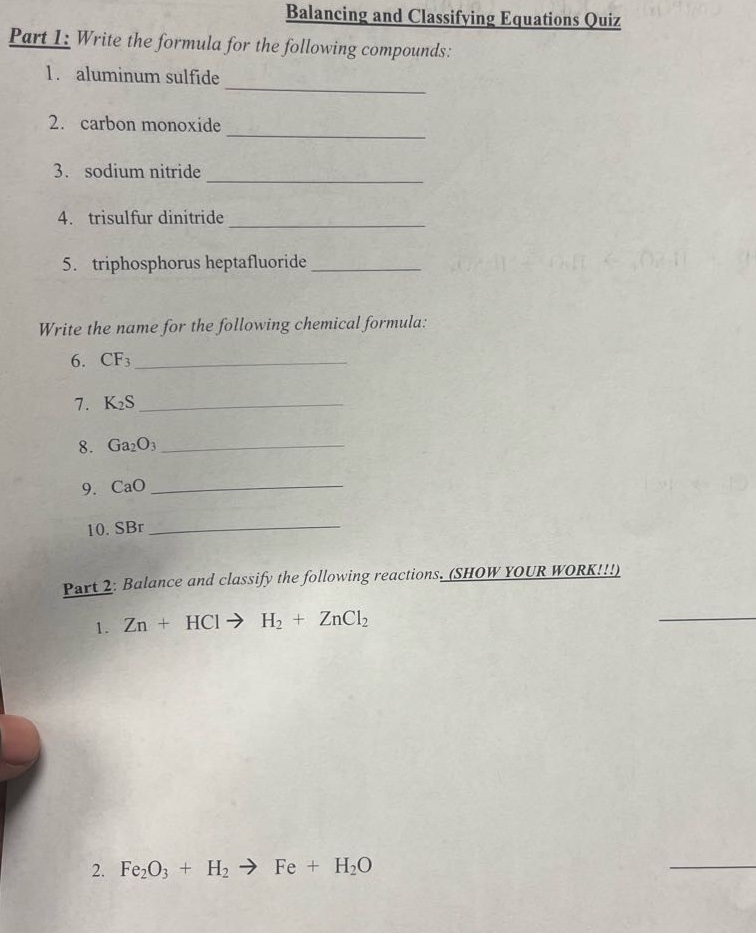
balancing and classifying equations quiz\npart 1: write the formula for the following compounds:\n1. aluminum sulfide \n2. carbon monoxide \n3. sodium nitride \n4. trisulfur dinitride \n5. triphosphorus heptafluoride \n\nwrite the name for the following chemical formula:\n6. cf₃ \n7. k₂s \n8. ga₂o₃ \n9. cao \n10. sbr \n\npart 2: balance and classify the following reactions. (show your work!!!)\n1. zn + hcl → h₂ + zncl₂\n2. fe₂o₃ + h₂ → fe + h₂o
Answer
Explanation:
Step1: Write formulas for compounds
- Aluminum has a +3 charge ($Al^{3+}$) and sulfide has a - 2 charge ($S^{2-}$). To balance the charges, the formula is $Al_2S_3$.
- Carbon monoxide has one carbon and one oxygen atom, so the formula is $CO$.
- Sodium has a +1 charge ($Na^{+}$) and nitride has a -3 charge ($N^{3 -}$). The formula is $Na_3N$.
- Trisulfur means 3 sulfur atoms ($S_3$) and dinitride means 2 nitrogen atoms ($N_2$), so the formula is $S_3N_2$.
- Triphosphorus means 3 phosphorus atoms ($P_3$) and heptafluoride means 7 fluorine atoms ($F_7$), so the formula is $P_3F_7$.
Step2: Name chemical formulas
- $CF_3$ is carbon - trifluoride.
- $K_2S$ is potassium sulfide. Potassium has a +1 charge and sulfide has a -2 charge.
- $Ga_2O_3$ is gallium(III) oxide. Gallium has a +3 oxidation state here.
- $CaO$ is calcium oxide. Calcium has a +2 charge and oxygen has a -2 charge.
- There is an error in $SBr$. It should likely be $SBr_2$ (sulfur dibromide) or other more stable compounds. Assuming it's $SBr_2$, it is sulfur dibromide.
Step3: Balance and classify reactions
Reaction 1: $Zn + HCl\rightarrow H_2+ZnCl_2$
- First, balance the chlorine atoms. There are 2 chlorine atoms in $ZnCl_2$, so we need 2 moles of $HCl$: $Zn + 2HCl\rightarrow H_2+ZnCl_2$. This is a single - displacement reaction as zinc replaces hydrogen in hydrochloric acid.
Reaction 2: $Fe_2O_3 + H_2\rightarrow Fe + H_2O$
- Balance the iron atoms. There are 2 iron atoms in $Fe_2O_3$, so we need 2 moles of $Fe$: $Fe_2O_3 + H_2\rightarrow 2Fe + H_2O$.
- Balance the oxygen atoms. There are 3 oxygen atoms in $Fe_2O_3$, so we need 3 moles of $H_2O$: $Fe_2O_3 + H_2\rightarrow 2Fe+3H_2O$.
- Then balance the hydrogen atoms. We need 3 moles of $H_2$: $Fe_2O_3 + 3H_2\rightarrow 2Fe + 3H_2O$. This is a redox reaction (reduction - oxidation) as iron is reduced and hydrogen is oxidized.
Answer:
- $Al_2S_3$
- $CO$
- $Na_3N$
- $S_3N_2$
- $P_3F_7$
- carbon - trifluoride
- potassium sulfide
- gallium(III) oxide
- calcium oxide
- (assuming $SBr_2$) sulfur dibromide
- Balanced: $Zn + 2HCl\rightarrow H_2+ZnCl_2$, Type: Single - displacement reaction
- Balanced: $Fe_2O_3 + 3H_2\rightarrow 2Fe + 3H_2O$, Type: Redox reaction