which best explains why water has a high specific heat?\no hydrogen bonds decrease the amount of energy that…
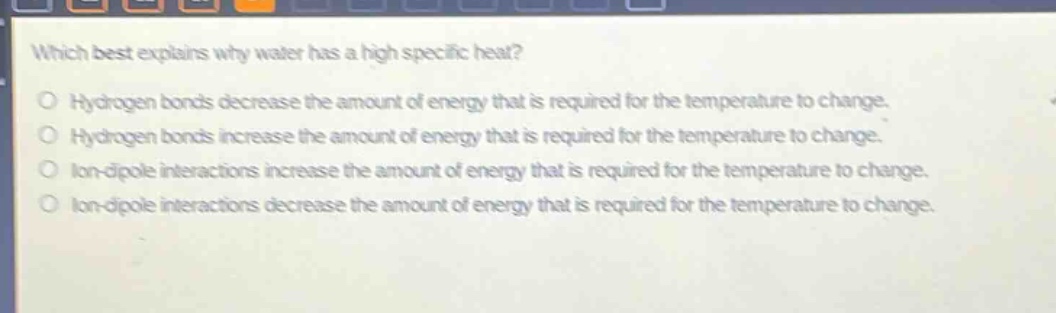
which best explains why water has a high specific heat?\no hydrogen bonds decrease the amount of energy that is required for the temperature to change.\no hydrogen bonds increase the amount of energy that is required for the temperature to change.\no lon - dipole interactions increase the amount of energy that is required for the temperature to change.\no lon - dipole interactions decrease the amount of energy that is required for the temperature to change.
Answer
Brief Explanations:
Water has hydrogen - bonding between its molecules. Hydrogen bonds are relatively strong intermolecular forces. A significant amount of energy is needed to break these bonds and change the temperature of water, thus increasing the specific heat. Ion - dipole interactions are not relevant here as water is a neutral molecule and there are no ions in pure water under normal conditions.
Answer:
Hydrogen bonds increase the amount of energy that is required for the temperature to change.