7. in beta - plus decay, what does a proton turn into? a. electron b. neutron c. positron d. neutrino 8…
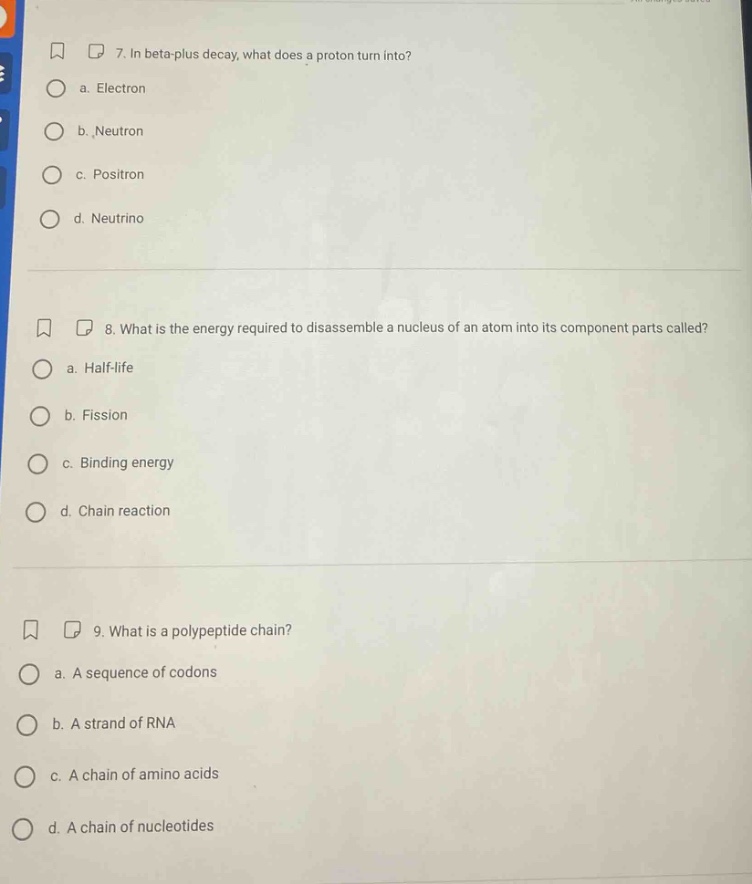
7. in beta - plus decay, what does a proton turn into? a. electron b. neutron c. positron d. neutrino 8. what is the energy required to disassemble a nucleus of an atom into its component parts called? a. half - life b. fission c. binding energy d. chain reaction 9. what is a polypeptide chain? a. a sequence of codons b. a strand of rna c. a chain of amino acids d. a chain of nucleotides
Answer
Answer:
- c. Positron
- c. Binding energy
- c. A chain of amino acids
Brief Explanations:
- In beta - plus decay, a proton changes into a neutron and emits a positron and a neutrino. The key product here is the positron.
- Binding energy is the energy needed to break a nucleus into its component nucleons. It holds the nucleus together.
- A polypeptide chain is formed by linking amino acids together through peptide bonds.