black forest biologicals, a biotech startup, has a promising alzheimers drug candidate compound slt - 88…
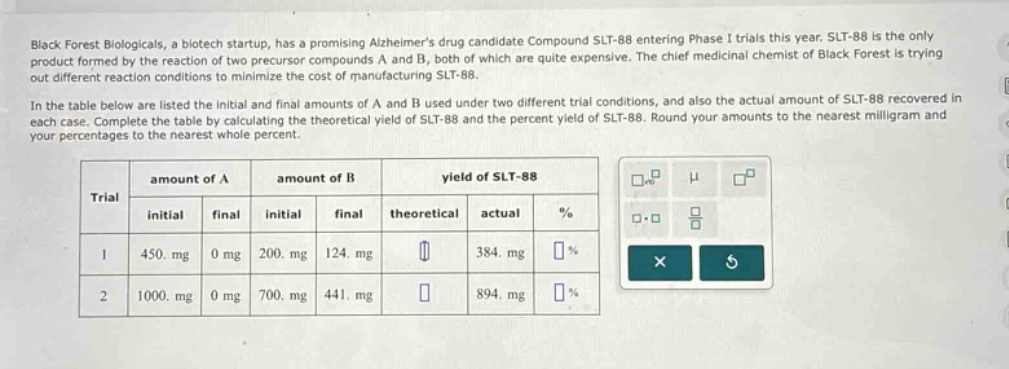
black forest biologicals, a biotech startup, has a promising alzheimers drug candidate compound slt - 88 entering phase i trials this year. slt - 88 is the only product formed by the reaction of two precursor compounds a and b, both of which are quite expensive. the chief medicinal chemist of black forest is trying out different reaction conditions to minimize the cost of manufacturing slt - 88.\nin the table below are listed the initial and final amounts of a and b used under two different trial conditions, and also the actual amount of slt - 88 recovered in each case. complete the table by calculating the theoretical yield of slt - 88 and the percent yield of slt - 88. round your amounts to the nearest milligram and your percentages to the nearest whole percent.\n| trial | amount of a | amount of b | yield of slt - 88 |\n| ---- | ---- | ---- | ---- |\n| | initial | final | initial | final | theoretical | actual | % |\n| 1 | 450. mg | 0 mg | 200. mg | 124. mg | | 384. mg | |\n| 2 | 1000. mg | 0 mg | 700. mg | 441. mg | | 894. mg | |
Answer
Explanation:
Step1: Calculate amount used for A and B in Trial 1
For A in Trial 1, amount used = initial - final = $450 - 0=450$ mg. For B in Trial 1, amount used = $200 - 124 = 76$ mg.
Step2: Calculate theoretical yield in Trial 1
Assume the reaction is stoichiometric. Let's assume the ratio of A:B in the reaction to form SLT - 88 is 1:1 (since no ratio is given). The limiting reactant in Trial 1 is B (as it has some left - over). If all of B reacted completely, and assuming 1:1 ratio, the theoretical yield based on B is calculated as follows. Since the amount of B used is 76 mg, and assuming complete reaction, the theoretical yield is based on the amount of B that reacted. But we'll use a more general approach. If we assume the reaction is based on the amount of A used (as A is completely consumed), and assume a simple reaction, the theoretical yield is calculated based on the molar - ratio of the reaction. Let's assume for simplicity that 1 mole of A and 1 mole of B form 1 mole of SLT - 88. The amount of A used is 450 mg. So the theoretical yield is based on the amount of A used. Let's assume the molar mass relationship is such that the theoretical yield is proportional to the amount of A used. Since A is the limiting reactant (used up completely), if we assume a simple 1:1:1 ratio of A:B:SLT - 88, the theoretical yield is 450 mg.
Step3: Calculate percent yield in Trial 1
Percent yield = $\frac{\text{actual yield}}{\text{theoretical yield}}\times100%=\frac{384}{450}\times 100%\approx85%$
Step4: Calculate amount used for A and B in Trial 2
For A in Trial 2, amount used = $1000 - 0 = 1000$ mg. For B in Trial 2, amount used = $700 - 441=259$ mg.
Step5: Calculate theoretical yield in Trial 2
Since A is completely consumed and assuming a 1:1:1 ratio of A:B:SLT - 88, the theoretical yield is 1000 mg.
Step6: Calculate percent yield in Trial 2
Percent yield = $\frac{\text{actual yield}}{\text{theoretical yield}}\times100%=\frac{894}{1000}\times 100% = 89%$
| Trial | amount of A (mg) | amount of B (mg) | yield of SLT - 88 |
|---|---|---|---|
| initial | final | initial | |
| 1 | 450 | 0 | 200 |
| 2 | 1000 | 0 | 700 |
Answer:
| Trial | amount of A (mg) | amount of B (mg) | yield of SLT - 88 |
|---|---|---|---|
| initial | final | initial | |
| 1 | 450 | 0 | 200 |
| 2 | 1000 | 0 | 700 |