3. blast furnaces give off many unpleasant and unhealthy gases. if the total air pressure is 1.29atm, the…
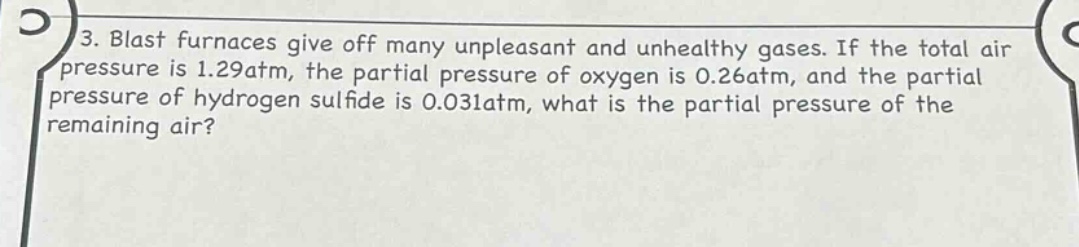
3. blast furnaces give off many unpleasant and unhealthy gases. if the total air pressure is 1.29atm, the partial pressure of oxygen is 0.26atm, and the partial pressure of hydrogen sulfide is 0.031atm, what is the partial pressure of the remaining air?
Answer
Explanation:
Step1: Recall Dalton's law
According to Dalton's law of partial - pressures, the total pressure $P_{total}$ is the sum of the partial pressures of all components in a gas mixture, i.e., $P_{total}=P_1 + P_2+P_3+\cdots$. Let $P_{O_2}$ be the partial pressure of oxygen, $P_{H_2S}$ be the partial pressure of hydrogen - sulfide, and $P_{remaining}$ be the partial pressure of the remaining air. Then $P_{total}=P_{O_2}+P_{H_2S}+P_{remaining}$.
Step2: Rearrange the formula to solve for $P_{remaining}$
We can rewrite the formula as $P_{remaining}=P_{total}-P_{O_2}-P_{H_2S}$. Substitute $P_{total} = 1.29$ atm, $P_{O_2}=0.26$ atm, and $P_{H_2S}=0.031$ atm into the formula: $P_{remaining}=1.29 - 0.26-0.031$. First, $1.29−0.26 = 1.03$ atm. Then, $1.03−0.031 = 0.999$ atm.
Answer:
$0.999$ atm