the boiling point of hcl is -85 °c and hi is -35 °c. which statement explains this observation?\nthe hcl…
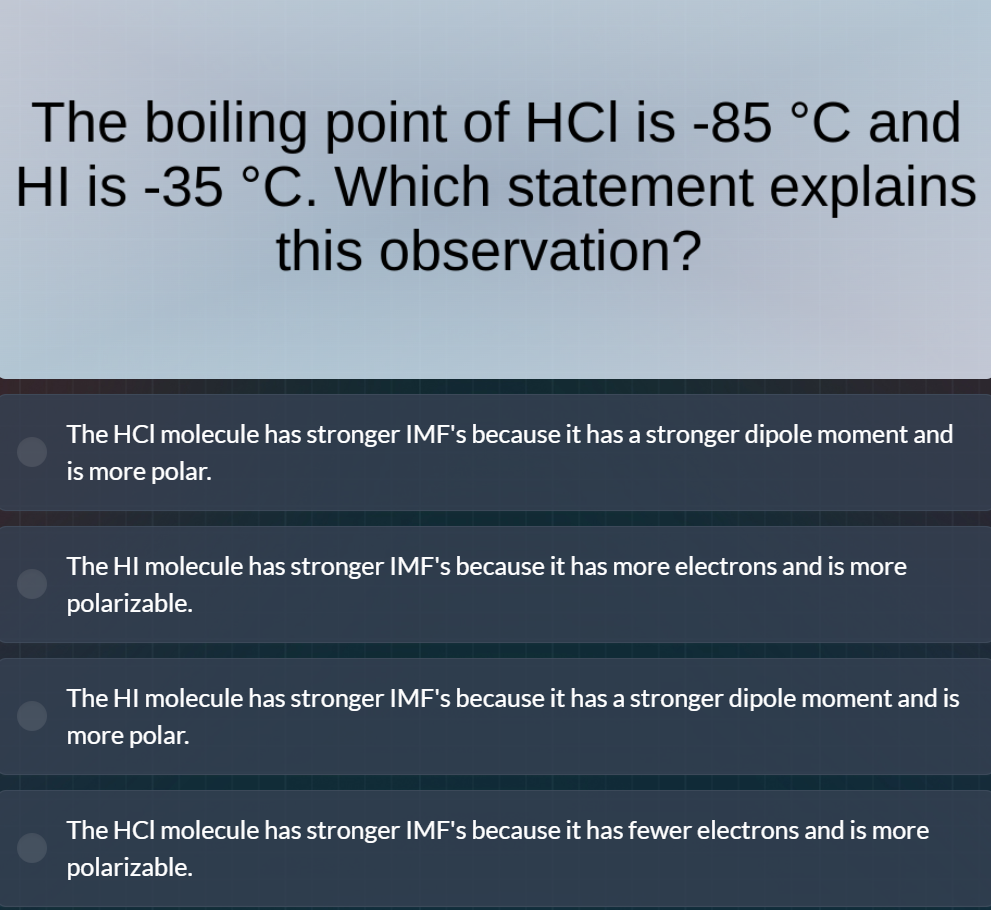
the boiling point of hcl is -85 °c and hi is -35 °c. which statement explains this observation?\nthe hcl molecule has stronger imfs because it has a stronger dipole moment and is more polar.\nthe hi molecule has stronger imfs because it has more electrons and is more polarizable.\nthe hi molecule has stronger imfs because it has a stronger dipole moment and is more polar.\nthe hcl molecule has stronger imfs because it has fewer electrons and is more polarizable.
Answer
Brief Explanations:
Boiling point correlates with the strength of intermolecular forces (IMFs): higher boiling points mean stronger IMFs. HCl is more polar (has a larger dipole moment) than HI, but HI has far more electrons, making it much more polarizable. For larger halogens like iodine, London dispersion forces (which depend on polarizability and number of electrons) dominate over dipole-dipole forces, resulting in stronger overall IMFs in HI, hence its higher boiling point. The other options are incorrect: HCl does not have stronger IMFs, and HI does not have a stronger dipole moment, nor do fewer electrons increase polarizability.
Answer:
B. The HI molecule has stronger IMF's because it has more electrons and is more polarizable.