for each bond, show the direction of polarity by selecting the correct partial charges. te - o te - s o - s…
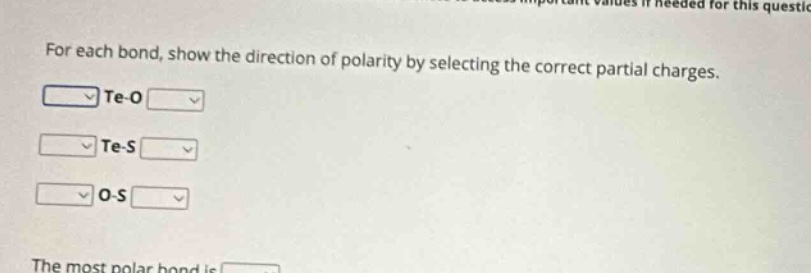
for each bond, show the direction of polarity by selecting the correct partial charges. te - o te - s o - s the most polar bond is
Answer
Explanation:
Step1: Recall electronegativity values
Electronegativity of O = 3.44, S = 2.58, Te = 2.1
Step2: Determine partial - charges for Te - O
Since O is more electronegative than Te, the partial - charge on Te is $\delta^{+}$ and on O is $\delta^{-}$.
Step3: Determine partial - charges for Te - S
Since S is more electronegative than Te, the partial - charge on Te is $\delta^{+}$ and on S is $\delta^{-}$.
Step4: Determine partial - charges for O - S
Since O is more electronegative than S, the partial - charge on S is $\delta^{+}$ and on O is $\delta^{-}$.
Step5: Calculate electronegativity differences
For Te - O: $\Delta\chi=3.44 - 2.1=1.34$; for Te - S: $\Delta\chi=2.58 - 2.1 = 0.48$; for O - S: $\Delta\chi=3.44 - 2.58=0.86$
Step6: Identify the most polar bond
The bond with the largest electronegativity difference is the most polar. So, Te - O is the most polar bond.
Answer:
Te - O: Te $\delta^{+}$, O $\delta^{-}$; Te - S: Te $\delta^{+}$, S $\delta^{-}$; O - S: S $\delta^{+}$, O $\delta^{-}$; The most polar bond is Te - O.