bromine forms covalent bonds because it has seven valence electrons, but neon has eight valence electrons…
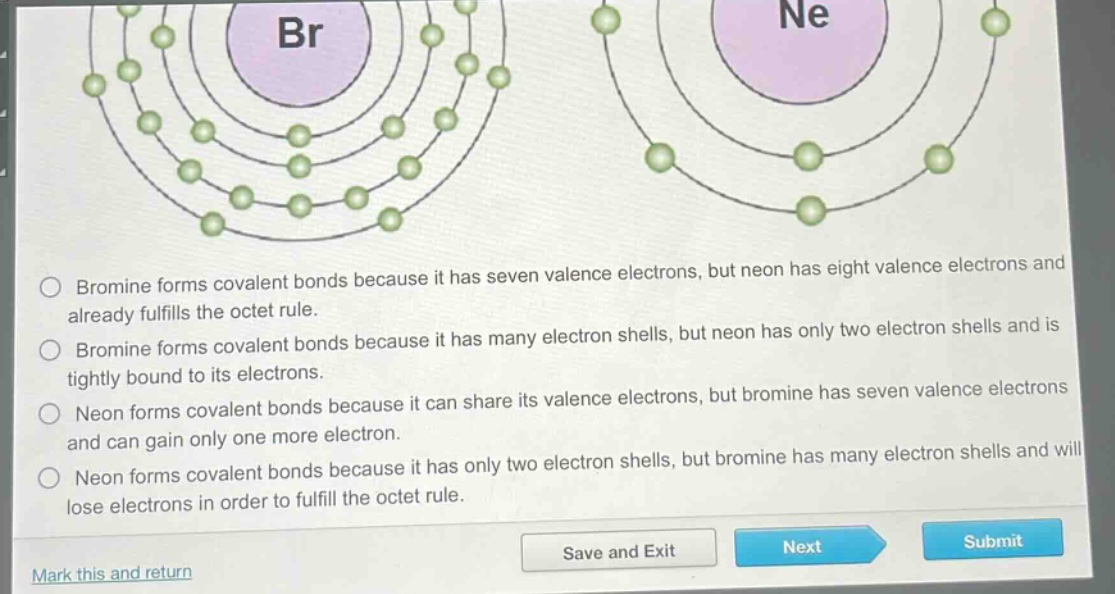
bromine forms covalent bonds because it has seven valence electrons, but neon has eight valence electrons and already fulfills the octet rule. bromine forms covalent bonds because it has many electron shells, but neon has only two electron shells and is tightly bound to its electrons. neon forms covalent bonds because it can share its valence electrons, but bromine has seven valence electrons and can gain only one more electron. neon forms covalent bonds because it has only two electron shells, but bromine has many electron shells and will lose electrons in order to fulfill the octet rule.
Answer
Brief Explanations:
Covalent bonds form when atoms share electrons to achieve a stable electron - configuration. Bromine has 7 valence electrons and needs 1 more to complete its octet, so it forms covalent bonds by sharing electrons. Neon has 8 valence electrons and already has a stable octet configuration, so it is inert and does not readily form covalent bonds.
Answer:
A. Bromine forms covalent bonds because it has seven valence electrons, but neon has eight valence electrons and already fulfills the octet rule.