ca₃(po₄)₂ + h₂so₄ → caso₄ + h₃po₄\nbalance this reaction if necessary.\na balanced\nb 1, 3, 3, 2\nc 1, 2, 3…
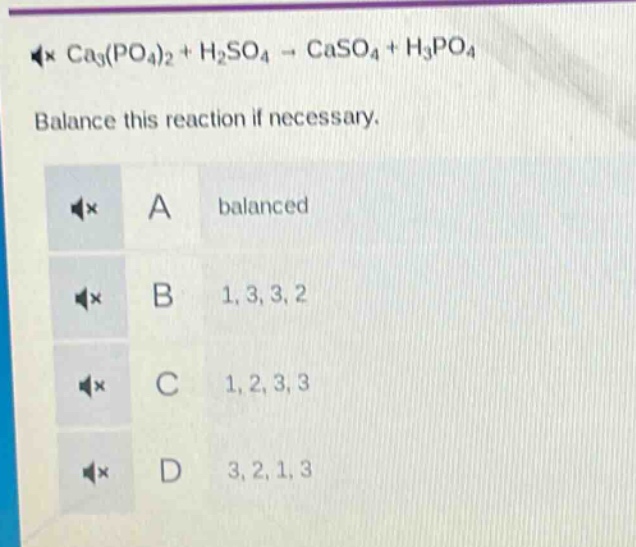
ca₃(po₄)₂ + h₂so₄ → caso₄ + h₃po₄\nbalance this reaction if necessary.\na balanced\nb 1, 3, 3, 2\nc 1, 2, 3, 3\nd 3, 2, 1, 3
Answer
Explanation:
Step1: Balance calcium atoms
There are 3 calcium atoms in $Ca_3(PO_4)_2$. So we need 3 moles of $CaSO_4$ on the product - side. The equation becomes $Ca_3(PO_4)_2 + H_2SO_4\rightarrow3CaSO_4 + H_3PO_4$.
Step2: Balance sulfate ions
Since we have 3 moles of $CaSO_4$, we need 3 moles of $H_2SO_4$ on the reactant - side. The equation is now $Ca_3(PO_4)_2+3H_2SO_4\rightarrow3CaSO_4 + H_3PO_4$.
Step3: Balance phosphate and hydrogen atoms
There are 2 phosphate groups in $Ca_3(PO_4)_2$. So we need 2 moles of $H_3PO_4$ on the product - side. The balanced equation is $Ca_3(PO_4)_2 + 3H_2SO_4=3CaSO_4+2H_3PO_4$. The coefficients are 1, 3, 3, 2.
Answer:
B. 1, 3, 3, 2