calculate the gibbs free energy for the following cell.\nhalf-reaction | e° (v)\ncl₂ + 2e⁻ → 2cl⁻ |…
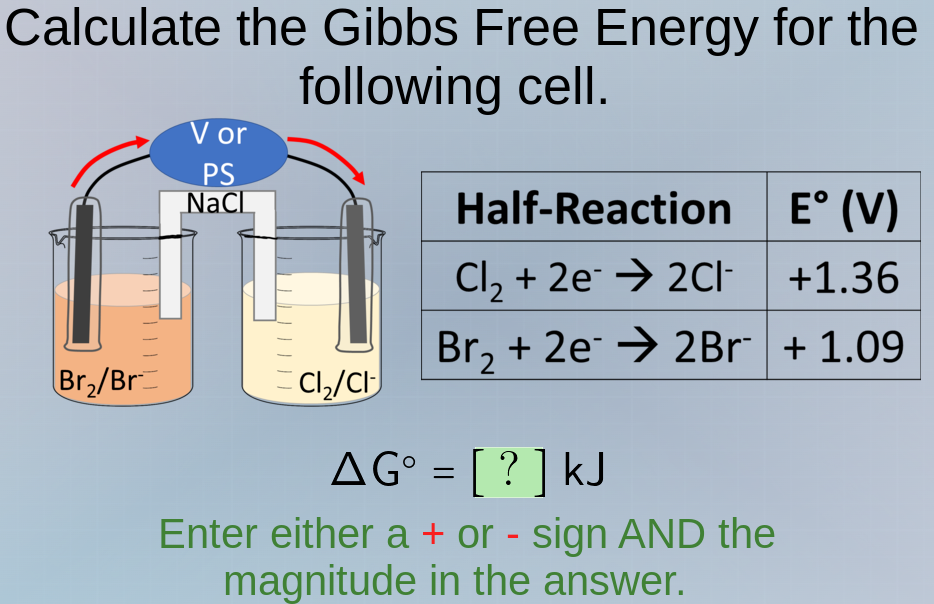
calculate the gibbs free energy for the following cell.\nhalf-reaction | e° (v)\ncl₂ + 2e⁻ → 2cl⁻ | +1.36\nbr₂ + 2e⁻ → 2br⁻ | + 1.09\nδg° = ? kj\nenter either a + or - sign and the magnitude in the answer.
Answer
Explanation:
Step1: Identify Oxidation and Reduction
In a galvanic cell, the half - reaction with higher (E^{\circ}) is the reduction reaction, and the one with lower (E^{\circ}) is the oxidation reaction (reverse of the given half - reaction). Reduction: (Cl_{2}+2e^{-}\rightarrow2Cl^{-}), (E^{\circ}{red}= + 1.36\ V) Oxidation: (2Br^{-}\rightarrow Br{2}+2e^{-}), (E^{\circ}{ox}=- 1.09\ V) (reverse of (Br{2}+2e^{-}\rightarrow2Br^{-}))
Step2: Calculate Cell Potential ((E^{\circ}_{cell}))
The formula for (E^{\circ}{cell}) is (E^{\circ}{cell}=E^{\circ}{red}(cathode)-E^{\circ}{red}(anode)) (or (E^{\circ}{cell}=E^{\circ}{red}+E^{\circ}{ox})). (E^{\circ}{cell}=E^{\circ}{red}(Cl{2}/Cl^{-})-E^{\circ}{red}(Br{2}/Br^{-})) (E^{\circ}_{cell}=1.36\ V - 1.09\ V=0.27\ V)
Step3: Determine the number of moles of electrons ((n))
From the half - reactions, the number of moles of electrons transferred ((n)) is 2 (since in both half - reactions, 2 moles of electrons are involved).
Step4: Calculate Gibbs Free Energy ((\Delta G^{\circ}))
The formula for (\Delta G^{\circ}) is (\Delta G^{\circ}=-nFE^{\circ}{cell}), where (F = 96485\ C/mol) (Faraday's constant), (n) is the number of moles of electrons, and (E^{\circ}{cell}) is the cell potential. First, substitute the values: (n = 2), (F=96485\ C/mol), (E^{\circ}_{cell}=0.27\ V) (Note: (1\ V = 1\ J/C)) (\Delta G^{\circ}=-2\times96485\ C/mol\times0.27\ V) (\Delta G^{\circ}=-2\times96485\times0.27\ J/mol) (since (V\times C=J)) Calculate the value: (2\times96485\times0.27 = 2\times26050.95=52101.9\ J/mol = 52.1019\ kJ/mol) So, (\Delta G^{\circ}=- 52.1\ kJ) (rounded to a reasonable number of significant figures)
Answer:
(- 52) (or more precisely (-52.1))