carbon disulfide burns with oxygen to form carbon dioxide and sulfur dioxide in the following manner: cs₂ +…
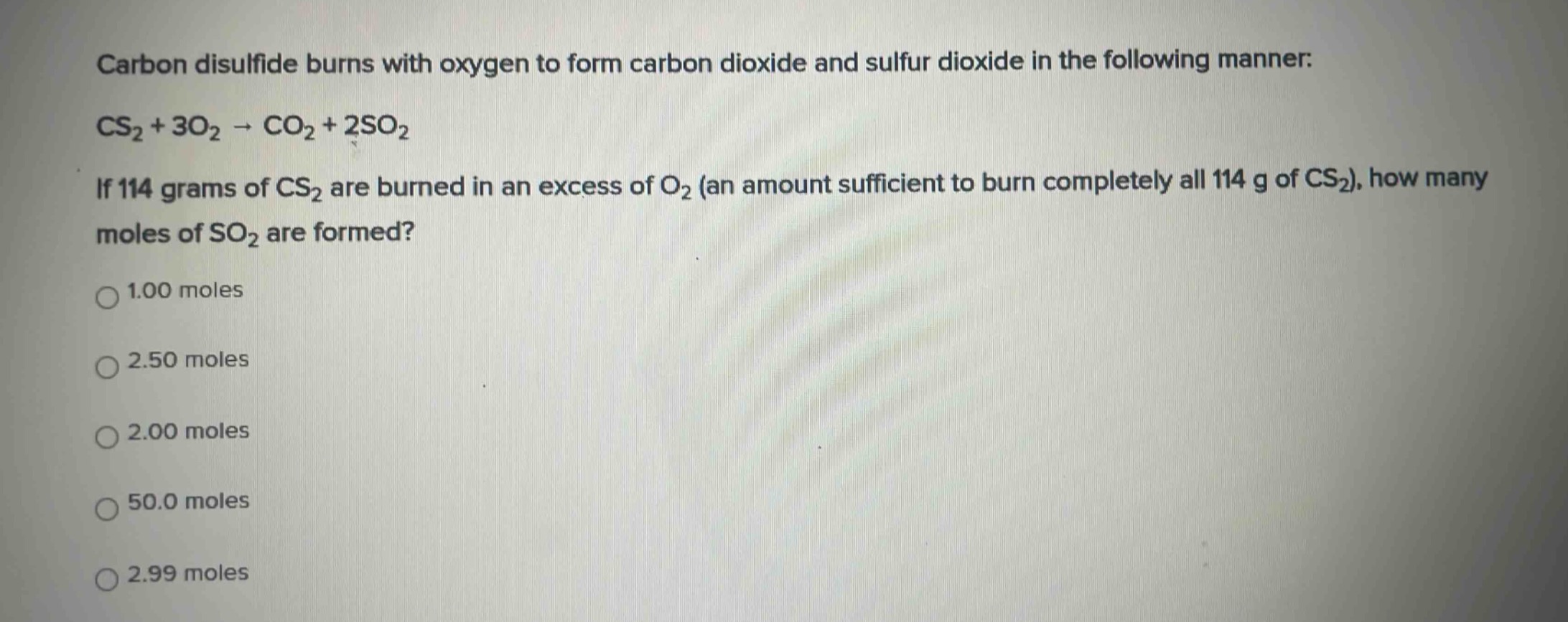
carbon disulfide burns with oxygen to form carbon dioxide and sulfur dioxide in the following manner: cs₂ + 3o₂ → co₂ + 2so₂. if 114 grams of cs₂ are burned in an excess of o₂ (an amount sufficient to burn completely all 114 g of cs₂), how many moles of so₂ are formed?\n1.00 moles\n2.50 moles\n2.00 moles\n50.0 moles\n2.99 moles
Answer
Explanation:
Step1: Calculate moles of CS₂
The molar - mass of CS₂ is (M_{CS_2}=12 + 2\times32=76\ g/mol). The number of moles of CS₂, (n_{CS_2}=\frac{m}{M}), where (m = 114\ g) and (M = 76\ g/mol). So (n_{CS_2}=\frac{114\ g}{76\ g/mol}=1.5\ mol).
Step2: Use mole - ratio from balanced equation
From the balanced equation (CS_2+3O_2\rightarrow CO_2 + 2SO_2), the mole - ratio of (CS_2) to (SO_2) is (1:2). That is, for every 1 mole of (CS_2) burned, 2 moles of (SO_2) are formed. If (n_{CS_2}=1.5\ mol), then the number of moles of (SO_2) formed, (n_{SO_2}=2\times n_{CS_2}). (n_{SO_2}=2\times1.5\ mol = 3\ mol) (There seems to be an error in the provided options. Based on the correct calculation steps: If we assume there is a small - rounding error in the options and we recalculate more precisely) The molar - mass of (CS_2): (C = 12.01\ g/mol), (S=32.07\ g/mol), (M_{CS_2}=12.01+2\times32.07 = 12.01 + 64.14=76.15\ g/mol) (n_{CS_2}=\frac{114\ g}{76.15\ g/mol}\approx1.497\ mol) (n_{SO_2}=2\times n_{CS_2}=2\times1.497\ mol\approx2.99\ mol)
Answer:
2.99 moles