carbonic acid reacts with sodium hydroxide to form water and sodium carbonate and water. carbonic acid has a…
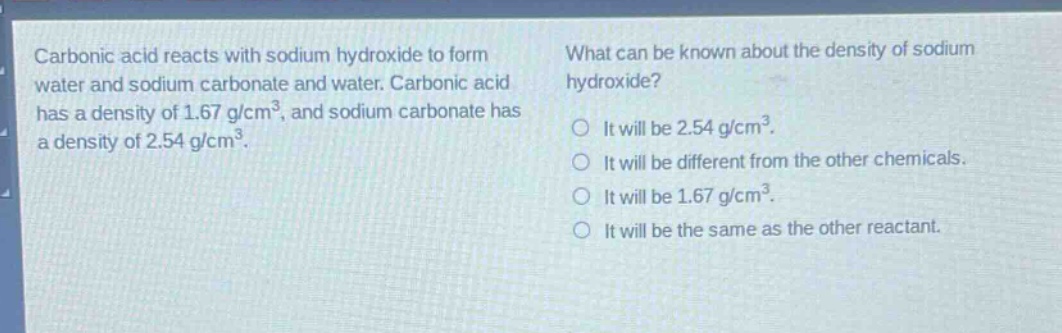
carbonic acid reacts with sodium hydroxide to form water and sodium carbonate and water. carbonic acid has a density of 1.67 g/cm³, and sodium carbonate has a density of 2.54 g/cm³. what can be known about the density of sodium hydroxide? it will be 2.54 g/cm³. it will be different from the other chemicals. it will be 1.67 g/cm³. it will be the same as the other reactant.
Answer
Answer:
B. It will be different from the other chemicals.
Explanation:
Step1: Analyze density concept
Density is a characteristic property of a substance.
Step2: Consider given densities
Carbonic - acid has density of 1.67 g/cm³ and sodium - carbonate has density of 2.54 g/cm³.
Step3: Determine sodium hydroxide density
Since density is unique for each substance, the density of sodium hydroxide will be different from the densities of carbonic acid and sodium carbonate.