during which changes of state do atoms that cannot move past one another become free to move?\nvaporization…
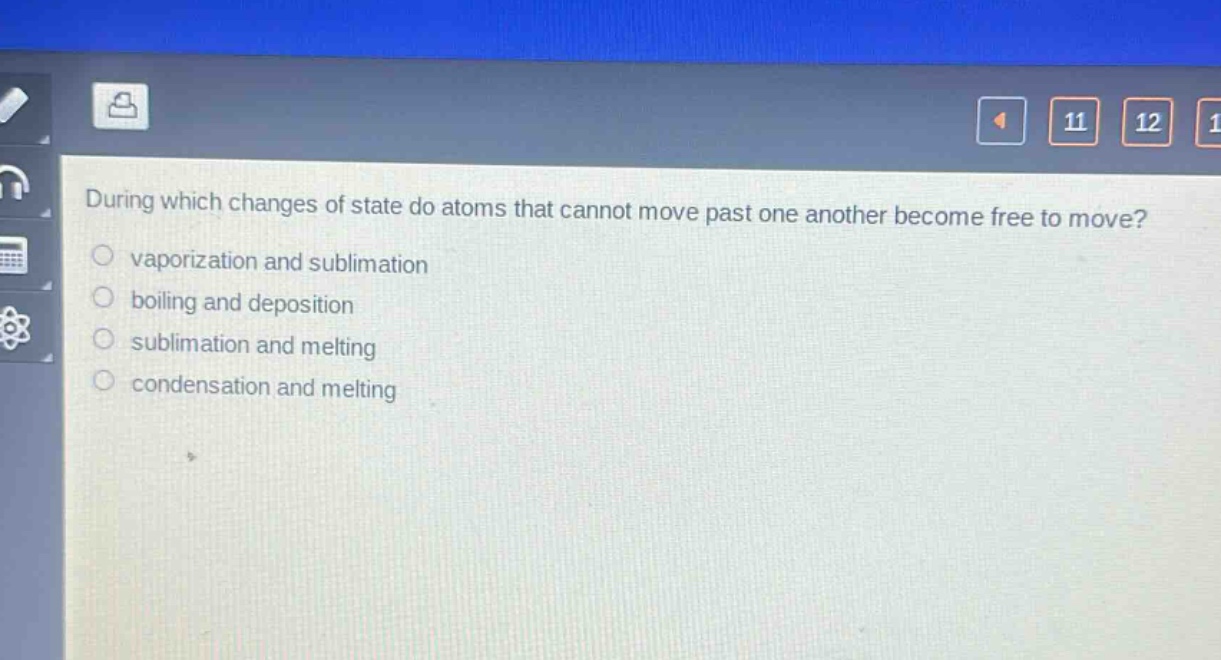
during which changes of state do atoms that cannot move past one another become free to move?\nvaporization and sublimation\nboiling and deposition\nsublimation and melting\ncondensation and melting
Answer
Brief Explanations:
- Vaporization: In vaporization (liquid to gas), atoms were in liquid (some movement but restricted) and become free in gas. But in the context of atoms that initially can't move (solid - atoms in solid can't move past each other), vaporization is not from solid.
- Sublimation: Sublimation is solid to gas. Atoms in solid can't move past each other, and in gas they are free.
- Boiling: Boiling is liquid to gas. Not starting from the state where atoms can't move (solid).
- Deposition: Deposition is gas to solid. Atoms become less free (opposite of what the question wants).
- Melting: Melting is solid to liquid. Atoms in solid can't move past each other, and in liquid they can move more freely (not as free as gas, but compared to solid, they are free to move relative to each other).
- Condensation: Condensation is gas to liquid. Atoms become less free.
Answer:
sublimation and melting