check for understanding:\n1) which formula represents an alkane?\na) c₂h₂ b) c₂h₄ c) c₃h₄ d) c₃h₈\n2) which…
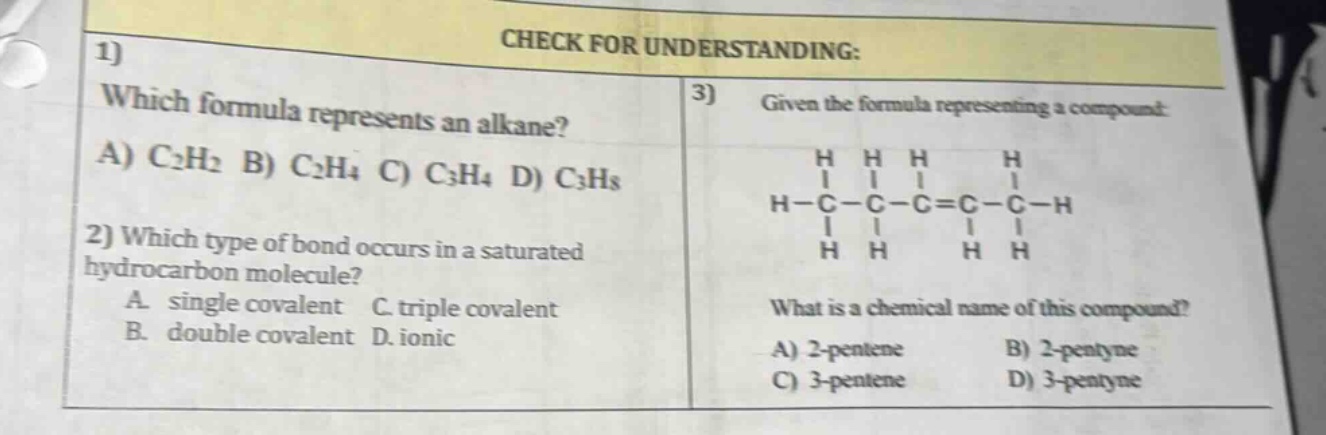
check for understanding:\n1) which formula represents an alkane?\na) c₂h₂ b) c₂h₄ c) c₃h₄ d) c₃h₈\n2) which type of bond occurs in a saturated hydrocarbon molecule?\na. single covalent c. triple covalent\nb. double covalent d. ionic\n3) given the formula representing a compound:\nh h h h\nh - c - c - c = c - c - h\nh h h h\nwhat is a chemical name of this compound?\na) 2 - pentene b) 2 - pentyne\nc) 3 - pentene d) 3 - pentyne
Answer
1)
Explanation:
Step1: Recall the general formula of alkanes
The general formula for alkanes is (C_nH_{2n + 2}).
Step2: Check each option
- For (n = 2) in (C_nH_{2n+2}), (H) atoms (=2\times2 + 2=6). So (C_2H_2) ((n = 2), (H=2)) and (C_2H_4) ((n = 2), (H = 4)) are not alkanes.
- For (n=3) in (C_nH_{2n + 2}), (H) atoms (=2\times3+ 2=8). (C_3H_4) ((n = 3), (H = 4)) is not an alkane, while (C_3H_8) ((n=3), (H = 8)) follows (C_nH_{2n+2}).
Answer:
D. (C_3H_8)
2)
Explanation:
Step1: Define saturated hydrocarbons
Saturated hydrocarbons have only single - covalent bonds. Alkanes are saturated hydrocarbons.
Step2: Analyze bond types
- Double covalent bonds ((C = C)) are in alkenes (unsaturated).
- Triple covalent bonds ((C\equiv C)) are in alkynes (unsaturated).
- Ionic bonds are between metal and non - metal (not in hydrocarbons which are made of (C) and (H), both non - metals).
Answer:
A. single covalent
3)
Explanation:
Step1: Count the number of carbon atoms
The longest carbon - chain has 5 carbon atoms ((n = 5), root name 'pent').
Step2: Identify the functional group and its position
There is a double bond ((C = C), alkene). Numbering the carbon - chain from the end closer to the double bond, the double bond is between (C - 2) and (C - 3). The name of the compound is based on the position of the double bond.
Answer:
A. 2 - pentene