a chemical engineer must calculate the maximum safe operating temperature of a high - pressure gas reaction…
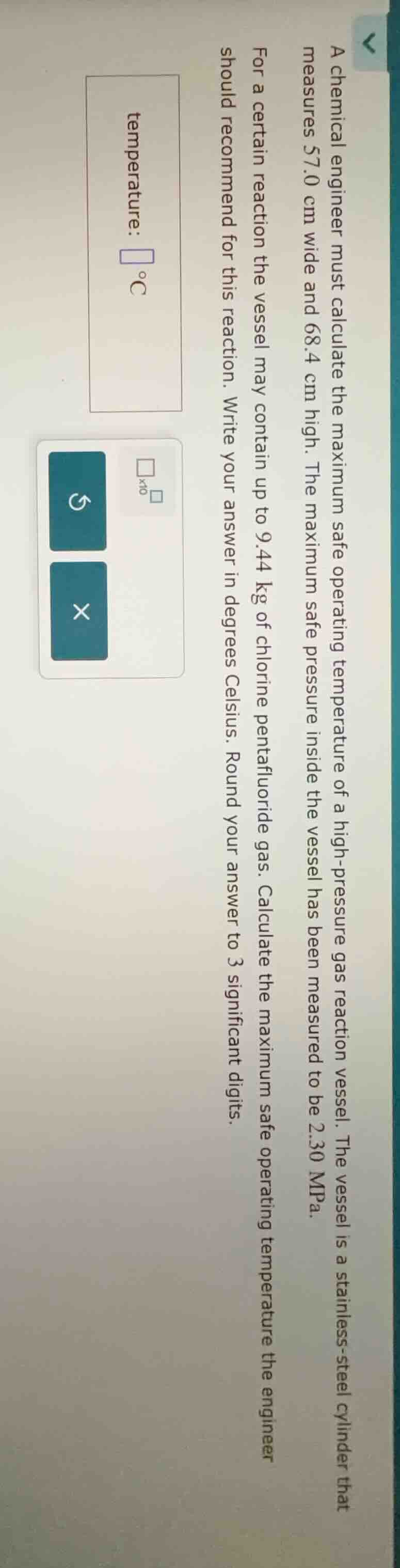
a chemical engineer must calculate the maximum safe operating temperature of a high - pressure gas reaction vessel. the vessel is a stainless - steel cylinder that measures 57.0 cm wide and 68.4 cm high. the maximum safe pressure inside the vessel has been measured to be 2.30 mpa. for a certain reaction the vessel may contain up to 9.44 kg of chlorine pentafluoride gas. calculate the maximum safe operating temperature the engineer should recommend for this reaction. write your answer in degrees celsius. round your answer to 3 significant digits.
Answer
Explanation:
Step 1: Determine the volume of the cylinder
The vessel is a cylinder, so we use the formula for the volume of a cylinder, ( V = \pi r^2 h ). The diameter is 57.0 cm, so the radius ( r = \frac{57.0}{2} = 28.5 ) cm. The height ( h = 68.4 ) cm. [ V=\pi\times(28.5)^2\times68.4 ] [ V=\pi\times812.25\times68.4 ] [ V\approx3.1416\times812.25\times68.4 ] [ V\approx3.1416\times55557.9 ] [ V\approx174500\space cm^3 = 174.5\space L \quad (\text{since } 1\space L = 1000\space cm^3) ]
Step 2: Calculate moles of chlorine pentafluoride (( ClF_5 ))
Molar mass of ( ClF_5 ): ( Cl = 35.45 \space g/mol ), ( F = 19.00 \space g/mol ), so molar mass ( M = 35.45 + 5\times19.00 = 35.45 + 95.00 = 130.45 \space g/mol ). Mass ( m = 9.44 \space kg = 9440 \space g ). Moles ( n=\frac{m}{M}=\frac{9440}{130.45}\approx72.37\space mol )
Step 3: Use the ideal gas law ( PV = nRT ) to find temperature ( T )
Pressure ( P = 2.30 \space MPa = 2300 \space kPa ) (since ( 1 \space MPa = 1000 \space kPa )), ( V = 174.5 \space L ), ( n = 72.37 \space mol ), ( R = 8.314 \space \frac{L\cdot kPa}{mol\cdot K} ) [ T=\frac{PV}{nR} ] [ T=\frac{2300\times174.5}{72.37\times8.314} ] [ T=\frac{401350}{599.7} ] [ T\approx669.3\space K ]
Step 4: Convert Kelvin to Celsius
( T(^\circ C)=T(K)-273.15 ) [ T(^\circ C)=669.3 - 273.15 = 396.15\approx396^\circ C ]
Answer:
( 396^\circ \text{C} )