a chemical reaction takes place inside a flask submerged in a water bath. the water bath contains 9.10 kg of…
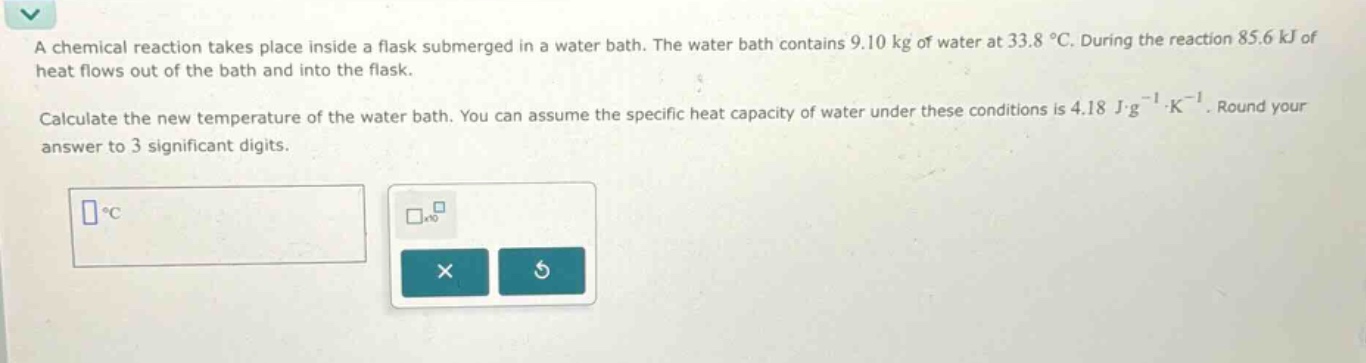
a chemical reaction takes place inside a flask submerged in a water bath. the water bath contains 9.10 kg of water at 33.8 °c. during the reaction 85.6 kj of heat flows out of the bath and into the flask.\n\ncalculate the new temperature of the water bath. you can assume the specific heat capacity of water under these conditions is 4.18 j·g⁻¹·k⁻¹. round your answer to 3 significant digits.
Answer
Explanation:
Step1: Convert mass to grams
The mass of water is $m = 9.10\ kg=9100\ g$.
Step2: Convert heat to joules
The heat lost by the water is $q=- 85.6\ kJ=-85600\ J$ (negative because heat is flowing out).
Step3: Use the heat - capacity formula
The heat - capacity formula is $q = mc\Delta T$, where $c = 4.18\ J\cdot g^{-1}\cdot K^{-1}$. We want to find $\Delta T$, so $\Delta T=\frac{q}{mc}$. Substitute the values: $\Delta T=\frac{-85600\ J}{9100\ g\times4.18\ J\cdot g^{-1}\cdot K^{-1}}$. $\Delta T=\frac{-85600}{9100\times4.18}\ K\approx - 2.25\ K$. Since a change in Kelvin is the same as a change in Celsius, $\Delta T\approx - 2.25^{\circ}C$.
Step4: Calculate the new temperature
The initial temperature $T_1 = 33.8^{\circ}C$. The new temperature $T_2=T_1+\Delta T$. $T_2 = 33.8^{\circ}C-2.25^{\circ}C = 31.6^{\circ}C$.
Answer:
$31.6$