a chemist has 200 ml of a 10% sucrose solution. she adds x ml of a 40% sucrose solution. the percent…
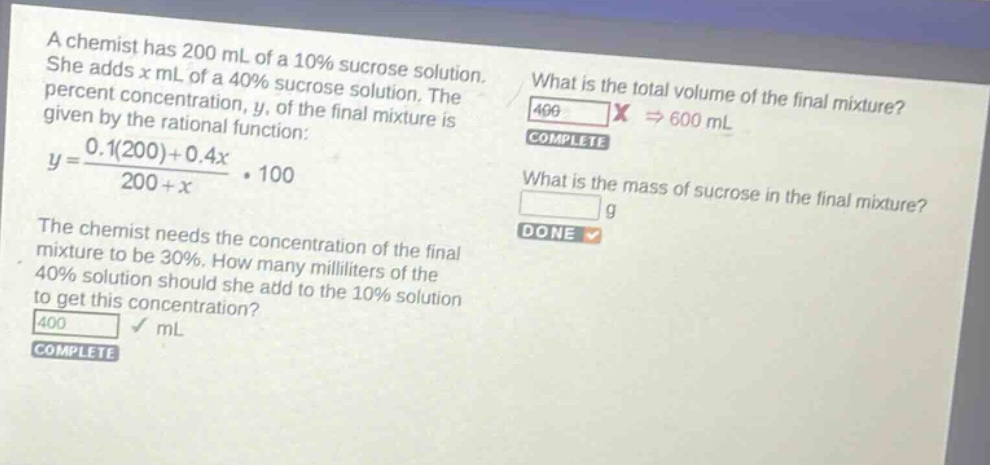
a chemist has 200 ml of a 10% sucrose solution. she adds x ml of a 40% sucrose solution. the percent concentration, y, of the final mixture is given by the rational function: $y = \frac{0.1(200)+0.4x}{200 + x}cdot100$. the chemist needs the concentration of the final mixture to be 30%. how many milliliters of the 40% solution should she add to the 10% solution to get this concentration? what is the total volume of the final mixture? what is the mass of sucrose in the final mixture?
Answer
Explanation:
Step1: Find total volume
The initial volume is 200 mL and $x$ mL of another solution is added. Given $x = 400$ mL, the total volume $V$ of the final mixture is the sum of the initial volume and the added - volume. So $V=200 + x=200 + 400=600$ mL.
Step2: Calculate mass of sucrose in final mixture
The mass of sucrose in the 10% solution is $0.1\times200 = 20$ g. The mass of sucrose in the 40% solution is $0.4\times400 = 160$ g. The total mass of sucrose $m$ in the final mixture is the sum of the mass of sucrose in the 10% solution and the mass of sucrose in the 40% solution. So $m=0.1\times200+0.4\times400=20 + 160 = 180$ g.
Answer:
180