a chemist working as a safety inspector finds an unmarked bottle in a lab cabinet. a note on the door of the…
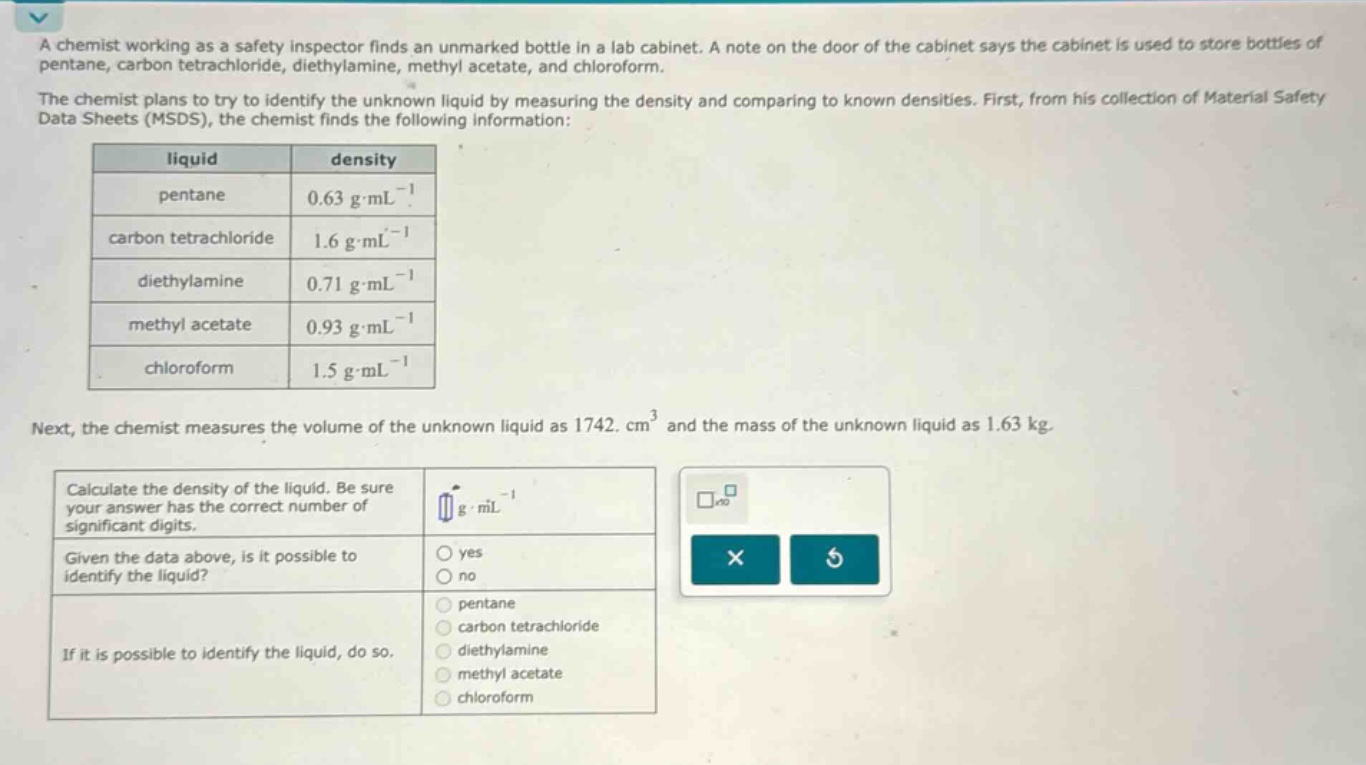
a chemist working as a safety inspector finds an unmarked bottle in a lab cabinet. a note on the door of the cabinet says the cabinet is used to store bottles of pentane, carbon tetrachloride, diethylamine, methyl acetate, and chloroform. the chemist plans to try to identify the unknown liquid by measuring the density and comparing to known densities. first, from his collection of material safety data sheets (msds), the chemist finds the following information: liquid density pentane 0.63 g·ml⁻¹ carbon tetrachloride 1.6 g·ml⁻¹ diethylamine 0.71 g·ml⁻¹ methyl acetate 0.93 g·ml⁻¹ chloroform 1.5 g·ml⁻¹ next, the chemist measures the volume of the unknown liquid as 1742. cm³ and the mass of the unknown liquid as 1.63 kg. calculate the density of the liquid. be sure your answer has the correct number of significant digits. given the data above, is it possible to identify the liquid? if it is possible to identify the liquid, do so.
Answer
Explanation:
Step1: Convert mass to grams
Since $1\ kg = 1000\ g$, then $1.63\ kg=1.63\times1000 = 1630\ g$.
Step2: Convert volume to mL
Since $1\ cm^{3}=1\ mL$, then $1742\ cm^{3}=1742\ mL$.
Step3: Calculate density
The density formula is $\rho=\frac{m}{V}$, where $m$ is mass and $V$ is volume. Substituting $m = 1630\ g$ and $V=1742\ mL$ gives $\rho=\frac{1630}{1742}\ g/mL\approx0.93\ g/mL$.
Step4: Check identification possibility
The calculated density of $0.93\ g/mL$ matches the density of methyl - acetate in the table. So it is possible to identify the liquid.
Answer:
$0.93\ g/mL$ yes methyl acetate